100 years of horror – Does Nosferatu still hold up?

Horror classic Nosferatu (1922) recently turned 100 years old – a milestone most films have yet to reach. I recently watched this centennial film in all its glory on Amazon Prime, making it the oldest movie I’ve ever watched. But as a 24-year-old film enthusiast indoctrinated into films by superheroes, CGI and animation, how does Nosferatu rate? Do the grainy colour-changing textures of the film affect its enjoyment? Does the atmospheric orchestral score compensate for the film’s lack of dialogue? Most importantly, does the film’s creepy atmosphere hold up? Well, when it comes to film, age is just a number, because I still thoroughly enjoyed Nosferatu.

I can see why Nosferatu is considered to be the origin of horror and vampires. It was made in the wake of the Spanish flu epidemic in 1918, and plays on the real fears of widespread disease and death. Nosferatu’s arrival to civilisation is as allegorical as it is literal. He brings fear, death and disease and disrupts the safety and security of a an otherwise stable society. It’s an interesting take on Bram Stoker’s original Dracula story, except the titular antagonist is much more dehumanised in this film. He’s permanently hunched, has pointy ears, freakishly long fingers, two sharp front teeth, and a pair of haunting, black eyes. His movements too, are ominously slow, giving the impression that this is no human, but a creature of the night. You can always feel his presence throughout the film even when he’s not on screen, simply by the effect he has on people and through the film’s atmosphere. If anything, the film’s grainy look adds to the creepy, claustrophobic feeling it thrives on. I thought it was interesting that the version I watched used different washes to indicate times of day – yellow and pink to indicate daytime, and green and blue indicating night. Even the vampiric descriptions in the book protagonist Hutter (Gustav von Wangenheim) reads are menacingly beautiful – describing the vampire in a way that forebodes Nosferatu’s presence.

The score does a perceptive job of creating the film’s creepy atmosphere. Depending on its intensity, it is a key indicator of the mood in each scene. When Hutter is enjoying time with his wife Ellen (Greta Schröder), the score is somber and peaceful. But when there is any mention of the supernatural, or when Hutter is travelling up a rocky road towards Count Orlok/Nosferatu’s castle, the score is much more ominous and intimidating. It gives an indication that something sinister is coming, and that something is a hunched, bloodthirsty vampire. The lighting of this film also enhances its atmosphere. From the use of a negative filter to convey the eeriness of Hutter’s journey, to the iconic shots of Nosferatu’s looming shadow, these simple effects remain genuinely creepy a century on.

Nosferatu still holds up not just because of its score and minimal effects to create its ominous atmosphere, but also by the themes of death and disease it conveys. There hasn’t been much in terms of remakes or reboots in the last century, aside from Werner Herzog’s 1979 remake, Nosferatu the Vampyre, and Shadow of the Vampire (2000) which was a fictionalised account of the making of the original. The 1979 remake didn’t particularly resonate with me, with it’s wooden acting, poor writing, and severe lack of tension. Willem Dafoe as Max Shreck/Nosferatu in Shadow of the Vampire does however sound appealing. Nonetheless, the influence of the original has disseminated throughout the horror genre. Travelling a long, eerie, mountainous road to an isolated location to create a sense of foreboding can be seen in films like The Shining (1980) and Evil Dead (1981), and even Nosferatu’s silent, predator-stalking-prey stance can be attributed in slashers like Halloween (1978) and Friday the 13th (1980). The Lighthouse (2019) and The Northman (2022) director Robert Eggers is writing and directing a remake of Nosferatu, with Pennywise himself Bill Skarsgård set to portray the titular role and Anya-Taylor Joy in an unknown role. If there was any filmmaker today who could adapt the atmosphere of the original Nosferatu for a modern audience, it would be Eggers; and I’m very much looking forward to it.

Why are modern day films and TV obsessed with popular 80s music?

There’s something delightfully nostalgic about watching a gratuitous fight scene to Bonnie Tyler’s 1984 hit ‘Holding out for a Hero‘ or a tense dance off between two groups of super humans to Kenny Loggins’s foot-tapping ‘Footloose‘ (both coincidentally recorded for the soundtrack to the film Footloose). The 1980s blessed pop culture with a colourful variety of both music and film, and aside from the fashion and various Pepsi and Coke ads, this vibrant synergy of music and film has become synonymous with the decade. Ever since films such as Footloose, cinema has continued to pepper soundtracks with the most popular 80s hits. But why has this tradition continued for so long in cinema? And why have films always gone back to 80s music rather than use the most popular contemporary music?  The answers to these questions can be gained from a delightful excursion through the history of pop music in film.

The pop musical energy of the 1980s is most often captured in fun, fast-paced flicks which don’t take themselves too seriously. A prime example that has excelled at using a retro soundtrack to capture this energy is the Guardians of the Galaxy series. Granted, not all of the songs in those films are of the ‘80s, but it seems overlaying a tense fight scene with some retro beats was the perfect way to capture the comical, vivacious energy of happy-go-lucky superhero characters. Even more mature superhero content such as The Boys and The Umbrella Academy series has used ‘80s pop music in some scenes to capture it’s hyper violent and sexual energy. What better way to capture this energy with music from a time where the world was more carefree and fun loving? ‘80s rock has trickled its way into Romcoms, coming-of-age films, and even horror. From 1999’s 10 Things I hate about You using Joan Jett’s Bad Reputation to incite title character Kat’s rebellious nature, to comedy horror Zombieland opening with a montage of zombie antics to Metallica’s For Whom the Bell Tolls, ‘80s rock seems to boost a film’s sense of chaotic fun. It ensures an audience knows a film doesn’t take itself too seriously in all the right ways.

Why do films use ‘80s music specifically? Pop music from the 60s and 70s is also often used in film, but they don’t quite capture the same vibe. 60s music in film tends to be used for more pure, cathartic energy with that raw guitar-bass-drum sound. Ironically one of the best examples is The Beatles’ Twist and Shout in the 1986 classic Ferris Bueller’s Day Off, in which Ferris gets a whole parade dancing to the sound of Paul, John, George and Ringo. The energetic yet edgy rock of the 70s however tends to be used to make gratuitous scenes more enjoyable. Take Lynyrd Skynyrd’s 1973 rock song Free Bird in 2014’s Kingsman: The Secret Service, which perfectly captures the slick yet violent energy of Colin Firth murdering a group of brainwashed Church goers. The increasing use of synthesisers and electrical experimentation with classic rock instruments in the 80s provided film soundtracks with the foot-tapping, cathartic energy of the 60s, but also the enjoyable edginess of the 70s. It seems therefore that 80s music effectively merges these two vibes together. Even the vast diversity of 90s music means it tends to capture different vibes in film. Known best for its cheesy Britney Spears, edgy Nirvana rock, or hard-hitting gangster rap, all of which have their own unique effect in film, but don’t quite match the colourful vibrancy of the 80s. As for the modern day, it’s difficult to imagine the music of Drake, Beyoncé or the Weekend to have the same colourfully nostalgic effect as Kenny Loggins, TOTO or Bon Jovi.

Thanks to modern day film and TV, the 1980s have come to be appreciated by a younger audience who aren’t quite old enough to have experienced the decade first hand. Given the huge revival in popularity of songs such as Kate Bush’s Running Up That Hill thanks to Stranger Things (which saw a staggering 9,900% streaming boost on Spotify) and Guns N’ Roses’ Sweet Child O’ Mine thanks to Thor: Love and Thunder, love of the ‘80s shows no signs of stopping. Who would have thought a decade could invoke such a unique sense of nostalgia for those that hadn’t even experienced it first time around? The ‘80s were a wonderfully simpler time with the coolest gadgets, cheesiest special effects, no internet spoilers, and enough funky synth tunes to keep Kevin Bacon dancing for decades to come.

Quentin Tarantino’s novelisation of Once Upon a Time in Hollywood – A Review

Once Upon a Time in Hollywood is one of my favourite films. From the colourful visual textures which capture the retro aesthetic of 1960s film, to the captivating performances of its stars (Leonardo DiCaprio as actor Rick Dalton, Brad Pitt as stunt double Cliff Booth, and Margot Robbie as Sharon Tate). The film encapsulates 1960’s Hollywood, following the lives of Rick, Cliff and Sharon as they negotiate the rapidly changing film industry. Years before it’s release, the film was written as a novel by Tarantino, having not yet decided whether it would be turned into a screenplay. When I discovered Tarantino had followed up on this and published a novelisation of Hollywood, I was overjoyed. The novel mostly follows the events of the film, except with additional backstory, characters’ inner thoughts, and enough references to 1960’s film to satisfy the ultimate film buff.

Tarantino’s novelisation mostly follows a couple of days in the lives of the stars of the film in February 1969, but divulges into past and future backstories and other narratives between this time. The backstories broaden the personal lives and personalities of characters portrayed in the film, providing a more detailed feel of the film industry in 1969. These include real-life 60’s actors James Stacy, Aldo Ray, and Sharon Tate (the former portrayed by Timothy Olyphant in the film), but most noticeably stuntman Cliff Booth. Booth is portrayed as possibly the most laid-back yet no-nonsense guy in Hollywood. The book details his WWII history, describes in detail how many times he’s got away with murder, extensive detail on his passion for Japanese cinema and erotic cinema, and even explains how he obtained his faithful pit bull Brandy. In essence, Booth is portrayed as the coolest psychopath in 60s Hollywood. In contrast to his best friend and anxiety-ridden Rick Dalton, Booth is content with his career and has accepted the changes occurring in Hollywood at the turn of the decade; happy to enjoy himself and be Dalton’s go-to guy.

Most of Rick Dalton’s scenes in the novel are the same as the film, except in the novel Tarantino provides Dalton’s ongoing inner thoughts during these scenes. I always appreciate this in books, as it distinguishes between characters act and how they feel. Dalton is struggling to find his place in a film industry that is rapidly changing from the one he’s used to. Attempting to make a transition from his hit 50’s Western show Bounty Law to 60’s film, Dalton has a choice of acting in films he’s not comfortable with or fading into obscurity. As such, most of Dalton’s thoughts are rather cynical, often containing spiteful comments about those around him which reflect his discontent with the changing film industry. Despite this, Dalton is strangely likeable. He mostly keeps his cynical thoughts to himself, in an attempt to appease those around him to maintain himself in a good light and accept the changes. Dalton finds himself playing the antagonist on the set of real-life 60’s Western series Lancer, which Tarantino details the plot of in certain chapters. This was one of my favourite aspects of the novel, effectively providing a story within a story; a morally ambiguous Western revenge tale which modestly reflects the genre which defined the previous decades of film which came before it. The way Dalton goes from playing Western hero in the 50’s to Western villain in the 60’s captures the essence of what Once Upon a Time in Hollywood is about; the fading of the classic Western scene into a New Hollywood which deviates from the norms of so-called ‘golden age’ of Hollywood.

The novelisation of Once Upon a Time in Hollywood provides many of the components that made the film stand out. It is a celebration of a by-gone era of TV and film, and details how actors of the time navigated their careers through this changing time. As in the film, the novel doesn’t have much of a conventional plot, but simply details the events of the characters’ lives and by doing so absorbs the reader into the era. As such, those who didn’t enjoy the film probably wouldn’t enjoy the novel, but then it’s unlikely you’d be reading the novel if you haven’t seen the film! The novel allows Tarantino to flex his extensive knowledge of the history of Hollywood, packed with references to the most well-known 60’s flicks like how Rick Dalton was nearly cast in The Great Escape, to more obscure references to Japanese cinema with a list of Cliff Booth’s favourite films from Japanese director Akira Kurosawa. The era is not just captured in it’s film scene, but also in it’s music scene. In the film, Californian radio station KHJ is constantly playing whenever the characters are driving, and just like the film, the novel constantly reminds the reader which music track or ad is playing; from Paul Revere & The Raiders to Red Apple Cigarettes (‘Take a bite and feel alright!’). It is this level of detail that underpins why Once Upon a Time in Hollywood is regarded as Tarantino’s ‘Magnum Opus’, and the novelisation is the perfect accompaniment to this celebration of 1960’s Hollywood.

‘Bullet Train’ Review: Move over Thomas, there’s a new No.1 train in town

What do you get if you cross the slick action of John Wick, the comedic timing of Deadpool, and the fastest train in the world? No, not a bad dad joke, but Deadpool director David Leitch’s action comedy film Bullet Train. This film is exactly what it sets out to be, a (literal) bullet train which takes you at breakneck speed through its humour, violence and action. This style of filmmaking matches the engaging cinematic energy of the Deadpool films, but with a unique setting and premise. What else would you expect when you place nearly a dozen deadly assassins together on the world’s first high-speed train line?

The film’s plot is fairly straightforward; several assassins end up on a Japanese bullet train together and are forced to face each other in one way or another. For a film so focused on its action and humour, it doesn’t need to have a more complex plot. Brad Pitt portrays ‘Ladybug’, the assassin film’s plot pivots on. Not only does Pitt yet again prove himself to be one of the masters of cinematic action, but also of comedic timing. He’s hilarious in this film, mixing the goofiness of Chris Hemsworth’s Thor with the quips of Ryan Reynolds’ Deadpool. Aaron Taylor Johnson, Brian Tyree Henry and Joey King were also standouts, portraying assassins ‘Tangerine’, ‘Lemon’, and ‘The Prince’ respectively. Tangerine and Lemon were effectively a British gangster comedy duo, constantly arguing over Lemon’s unusual obsession with Thomas the Tank Engine, which was hilariously ironic given the film’s setting. Joey King’s ‘The Prince’ was a no-nonsense assassin posing as an innocent schoolgirl, who could seamlessly slip between the two. Being set in Japan, the film also boasted several Japanese actors, namely Andrew Koji as ‘The Father’ and the legendary Hiroyuki Sanada as ‘The Elder’ who only polished the film’s razor sharp slickness with their cut-throat Katana action. There is even a few surprise cameos along the way, which make you laugh purely at the fact that said actors agreed to take part in such a ridiculously fun film.

The cast and premise of the film are at the forefront of what make it a summer must-watch, but it’s the little things that make this film standout. The little details of the plot that eagle-eyed moviegoers will notice which are paid off later, the tight camerawork and gorgeously colourful lighting on each of the different train carriages and stations, all add to the visceral, exciting energy that Leitch pulls off. The film introduces each assassin with colourful neon lettering also dubbed in Japanese, creating a stylistic, almost comic-book feel to the film’s meticulous energy. The only times we aren’t on the bullet train are when the film provides flashbacks to characters’ past, which are brief enough to not take us out of the fun of the train, but just enough to weave the plot together. Thanks to the lighting and camerawork, the film convinces its audience that we are on the bullet train with the assassins experiencing the mayhem first hand.

Bullet Train excels mostly because it appeals to both the casual moviegoer and the serious moviegoer. It’s unique and accessible premise topped with its quip-filled humour make it an easily enjoyable summer film, but it’s meticulously sleek filmmaking style makes it stand out as a thoroughly enjoyable action film worthy of the John Wick hall of fame. It is a film about both good and bad luck, and about fate. Is it fate that decides who lives and who dies? Is it fate or skill which allows characters to survive? As Brad Pitt’s Ladybug says, ‘Fate is just bad luck’. The film addresses these types of conundrums in interesting ways, and makes you question whether there even is such thing as fate or luck. What better way to address them than on an assassin-filled 200mph train journey? If Edgar Wright and Quentin Tarantino agreed to make a film together on the condition it was full of Thomas the Tank Engine jokes, it would probably result in something like Bullet Train.

Harry Potter and the Cursed Child is the closest thing to real-life magic

When Deathly Hallows was published in 2007, if you’d have told a nine-year-old Gareth that the next Harry Potter story would be a stage play, I most likely would’ve been flabbergasted. Seeing the magic come to life on the big screen is one thing, but to see it come to life completely on stage is something else entirely. From the simple things like levitating books to the seamless transition between scenes, Harry Potter and the Cursed Child clearly utilises the special effects of a theatre to their highest potential. It is almost like a real-life magic show; many of the feats of magic performed on stage really make you think ‘How did they do that?!’. Some were so fantastical that the audience erupted in applause in the middle of the scene. Whilst the special effects are arguably the core of the production, the play itself provides a heartfelt story with everything we love about the original Harry Potter stories, and more.

Harry Potter and the Cursed Child is a stage play which has been running at the Palace Theatre in London (also at various other theatres around the world) since 2016. It is separated into two parts, which are effectively two separate plays. I remember first hearing the announcement that the eighth Harry Potter story would take place on stage, and that it would be about Harry’s son Albus Potter at Hogwarts. Needless to say I was ecstatic, although it was only until recently that I finally got around to seeing it! After seven books and eight films, what better idea than to have a new Harry Potter story performed live on stage. Without revealing much of the plot, Cursed Child features adult versions of our childhood favourites; including Harry, Ginny, Ron, Hermione and a more-or-less reformed Draco Malfoy. The stars of the show however are Albus Potter and his best friend Scorpius Malfoy (Draco’s son). The play revolves mostly around Albus’s relationship with his father, and how he deals with the legacy of being the son of the famous Harry Potter who stopped the dark Lord Voldemort. In addition, it revolves around Albus’s relationship with Draco; a friendship which provides much of the heart and humour of the play. Luke Sumner, who played Scorpius when I went to see it, was a substantial stand-out; he was so animated and made the character his own, getting many laughs out of the audience. Scorpius is much unlike his father, being rather shy and socially awkward at times, yet clearly with a heart of gold. Thomas Aldridge who played Ron also shined, easily getting the most laughs out of the audience with his whimsical Weasley humour. Even James Howard who played Draco was a highlight, giving us a sympathetic insight into Draco’s character that we’ve never seen before in a Harry Potter story.

I cannot talk about Cursed Child without mentioning the special effects. They push the limits of what is possible on stage, and for that I have the upmost admiration for those who organise it. The fire and light used to represent the spells was bedazzling, one which stood out to me was how they did a certain Patronus spell; wonderfully creative and unique in a way I was pleasantly surprised by. The play also utilises the effects of lighting to create seemingly magical effects, to hide or highlight certain things on stage to cleverly divert the audience’s attention. One scene was even portrayed as being entirely submerged underwater, the actors seemingly swimming around and later appearing in a real pool of water at the front of the stage. The special effects also made the play particularly frightening at times, highlighting the darker elements of the wizarding world with dementors flying around the audience and ominous sound design and lighting to make the audience feel as vulnerable as the characters on stage. The transitions between scenes were done seamlessly so they would never take you out of the play; stage hands dancing around sweeping their magical cloaks to clear the stage and set the scene.

Harry Potter and the Cursed Child opened my eyes to the effort and organisation that must go into creating such a vast stage production. It isn’t like a film where if something goes wrong you can simply restart the take. If something goes wrong on stage you must improvise and make the most of it so as to not take the audience out of the story. Everything from the actor’s lines to the rigging of the effects must be so perfectly timed as to provide an eloquent and bedazzling production which as one of the staff proclaimed as we entered the theatre, will ‘melt your brain’. Stage plays also allow actors to give their performances their all, and Cursed Child is undoubtedly no exception. The cast provide us with newfound appreciation for characters we know, and the ones we’re introduced to. The narrative is well maintained across the two parts, although I enjoyed part 2 more since the stakes and tension were much higher. As someone who doesn’t go to the theatre that often, Cursed Child also opened my eyes to the realms of possibility and enjoyment that theatre plays provide. It made me want to see more stage productions and what they’re capable of. It is a play that not only Potterheads will love, but anyone of any age; it is truly a once in a lifetime real-life magic show.

Lightyear review: Pixar takes Buzz to infinity and beyond

You can see the sweat on Buzz Lightyear’s face as he propels through the stars at hyper speed. You can hear the retro-style sci-fi sound effects scattered throughout the adventure. The shot of a lone space ranger floating through space shows the terrifying magnificence of the universe. More than anything, Lightyear shows the cosmic wonder of space exploration, and how Pixar are the pinnacle of film animation. It is a classic heartfelt Pixar romp disguised as a grand space adventure. Chris Evans’ voice turns what was originally a toy into a real person, Michael Giacchino’s epic score transports you to the unknown plains of T’Kani Prime and makes you feel as if you were travelling at light speed.

Lightyear is framed as the movie within the Toy Story universe which inspired the Buzz Lightyear toy line. This is reflected in the film’s 90s style sound effects, showing the care the sound team placed into the film which we’ve come to expect from Pixar. Even the Giacchino’s score somewhat reflects this; providing Buzz with a classic hero’s ‘riff’ throughout the film. which I loved. The film delivers what you’d expect from a Buzz Lightyear spin-off and more. Although this time around, it’s less about the heart and more about the adventure through space. Whilst it is appropriately heartfelt and poignant in places, Lightyear reflects how the stunning cinematography and visuals show how far animation has come. From intricate new landscapes on unknown planets to the vast expanse of open space (especially a spectacle to admire in IMAX), Lightyear is possibly the most stunning animated film of the year so far. It clearly intended to go lightyears beyond the scale of Toy Story; Andy’s room to Buzz in Toy Story is the entire universe to Buzz in Lightyear. Lightyear was undoubtedly going to contain nods to the first Toy Story, which are scattered just the right amount throughout the film. Not too much that the film feels it can’t stand on it’s own without the legacy of the original, but not too little that the source material is under appreciated by the filmmakers.

The film introduces us to some likeable new faces, which become integral to the film’s core message. On a mission to save quite possibly everything he cares about, Buzz is teamed up with the likes of Izzy (Keke Palmer), Mo (Taika Waititi), Darby (Dale Soules), and a hilariously adorable robot cat called Sox (Peter Sohn). Each of these characters bring something unique to the roster, and not only learn something about themselves, but teach Buzz a valuable Pixar take-home lesson which we can all relate to. Sox is undoubtedly a stand out; providing that quizzical humour of a naive android companion in all the right moments. What sci-fi adventure wouldn’t be complete without an interstellar cat? The film also puts an interesting spin on Buzz’s nemesis; Zurg. Not quite emperor in this iteration, but having a level of sympathetic depth which we’ve come to expect from, well, most movie villains at this point. Once again, the animation shines particularly with Zurg’s design; an intimidating, anime-inspired robot body which is about 10 times the size of Buzz and his companions. There was even some subtle nods to classic sci-fi cinema; including Alien, Star Wars, possibly even The Terminator which I really appreciated.

As a guy who used to run around his neighbourhood dressed as Buzz Lightyear, this film not only tingled my nostalgic affection for Toy Story, but also took me on a fantastic animated adventure through space. Lightyear is a quality film regardless of its connections to Toy Story. As with any new Pixar film, it shows how far animation has come in delivering stunning new visuals, fantastical sound design and musical score. Pixar are known for turning an out-of-this-world setting into a down to earth, emotional story which wells the throats of movie-goers. Lightyear certainly isn’t the most down to earth Pixar story to date, but it doesn’t need to be. It is a new story inspired by a beloved character, with a gorgeous new setting and engaging story fresh enough to entertain any audience and well throats at the right moments. Does it make me want to run around my neighbourhood dressed as Buzz again? Of course it does. Although it makes me want to go slightly beyond my neighbourhood.

‘Batman: Unburied’ Review: An auditory adventure through Gotham City

Audio drama is one of the most unique styles of entertainment. It is one of the only ways of telling stories which relies on only one of the senses. It shows how much we rely on sound and audio to be entertained and to be told a gripping story. Batman: Unburied is the first in a series of audio dramas on Spotify set in the DC comics universe. This isn’t just a story of Batman being read off a page; it is a living, breathing story with a musical score, sound effects and some compelling voice acting. Much like reading a book however, the lack of visual components allows the listener to picture the story in their mind; relying on the sounds of Gotham City and what the character’s interactions would sound like. For me, it does this very effectively, I felt as if I was watching the story unfold in my head. The story itself explores the fractured psyche of Bruce Wayne, specifically where Bruce Wayne ends and Batman begins (no pun intended).

Winston Duke stars as the caped crusader as he unravels the mystery behind a series of gruesome murders committed by a man known only as ‘The Harvester’. Interestingly, Batman is absent for a while in the story, the first few episodes focusing on the more innocent side of Bruce Wayne. The story begins with Bruce working as a forensic pathologist in Gotham Hospital with his still-living father Thomas. We get a glimpse into what Bruce’s life would be like if his parents had not been shot down on that fateful night, as he initially has no memory of Batman. This is where Duke’s voice performance shines; he gives us a more sensitive, human side to Bruce that we haven’t really seen before in other mainstream media. He shows the comfort and care Bruce finds with still having his parents around in adulthood, yet still portrays his slightly unhinged side as the story unfolds (although I won’t deny his Batman voice does take some getting used to). I also never would’ve imagined Lucius Malfoy himself, Jason Isaacs, would be such a good Alfred; providing that British charisma which is so synonymous with the character. Hasan Minhaj also provides a seemingly more innocent yet charismatic portrayal of the Riddler, as he is forced to help Barbara Gordon (Gina Rodriguez) uncover the mystery of the Harvester with no signs of the world’s greatest detective.

The series frequently reminded me of the 90s Batman animated series in its tone and nods to the extended Batman mythos. This Gotham feels like that more animated, slightly supernatural city that we’ve had in the series and the Batman Arkham games. One of my favourite aspects of the series was its exploration of the dual identity of Bruce Wayne and Batman. Why does Bruce put on the cape and cowl every night? Does he do it for the memory of his parents? Or is there another, more profound reason? Moreover, how does much of a mental toll does being Batman take on this sensitive, naive version of Bruce Wayne? The fact that the series opens with a completely different angle on the story of Bruce Wayne provides enough intrigue to get listeners interested and keep that interest going. This isn’t just a story of Batman; it’s a murder mystery, a psychological thriller and almost a supernatural fantasy at some points. It’s a story that can be enjoyed by non-Batman fans, but Batman fans will appreciate the nods to the wider universe and its various surprises along the way. It doesn’t just divulge into Bruce Wayne, it divulges into certain other characters from the Batman universe which gives them a level of depth and intrigue which we’ve never seen before in mainstream media.

New Daredevil series in the works: What to expect and what to be wary of

With the news that Marvel have all but officially confirmed that a new series of Daredevil is on the way, I am nothing short of thrilled, not at all surprised, and only a little bit wary. According to Variety.com, NBC drama writers Matt Corman and Chris Ord are set to write and executive produce a new Daredevil series for Disney plus. Reps for Marvel and both Corman and Ord have yet to comment, making this news an ‘unofficial’ announcement. However, with the previous news that a Daredevil reboot was listed as an upcoming project in Production Weekly, and given the appearances of Charlie Cox’s Matt Murdock and Vincent D’Onofrio’s Kingpin in mainstream MCU projects, the news comes as little surprise.

Given the grand, cinematic finale to 10 years of films that was Avengers: Endgame, it seems Marvel are going in new directions as they attempt to keep their golden MCU goose afloat. For the most part, these new directions have paid off. The more visceral, psychological tone of the Moon Knight series, and the darker, much more violent nature of Doctor Strange in the Multiverse of Madness has been something which I and other fans alike have substantially appreciated. Topped with the fact all of Marvel’s darker, grittier Netflix shows have moved over to Disney plus, there is indication that Marvel is looking to focus on some more gritty, street-level stories and characters. Creating a new Daredevil series would certainly benefit the MCU in this way. Amongst Marvel’s street-level vigilantes, Daredevil certainly ranks as one of their most popular. It would be interesting to see some real vigilantism and crime occurring in the MCU, which would provide refreshing respite from all the cosmic multiverse madness. This would help to ground the MCU in reality much more, and give it an edge which many argue it has been lacking in recent years.

Netflix’s Daredevil series is possibly one of the best things Marvel has produced in recent years, and it wasn’t even truly acknowledged by the wider MCU until recently. As previously mentioned, the biggest allusion to more Daredevil content was the appearance of its two key players in Spider-Man: No Way Home and Hawkeye, but the second biggest was Marvel’s announcement of an Echo Disney plus series. Echo/Maya Lopez (Alaqua Cox) appeared in Hawkeye as an antagonist; the leader of the Tracksuit Mafia, overseen by D’Onofrio’s Kingpin. Echo made her first comic book appearance in David Mack’s Daredevil: Parts of a Hole in which her alter ego, Maya, falls in love with Matt Murdock, but Echo has a blood lust for Daredevil. Much of the plot involving Echo and Kingpin in Hawkeye was directly inspired by this storyline, from their uneasy father-daughter relationship to the ambiguous ending of the Kingpin’s fate at Echo’s hand. The fact that much of Hawkeye was inspired by a Daredevil comic, introducing two key players in Daredevil’s world, it wouldn’t surprise me if Charlie Cox made his first official MCU appearance as the Man Without Fear in the Echo series. Perhaps this would lead on to explore his relationship with Echo in the series, or in any future Daredevil content. Furthermore, given that in Parts of a Hole Kingpin survives the assassination attempt on his life at Echo’s hand, I can only hope they follow they same route in future MCU projects and give us the portentous reunion between Daredevil and Kingpin.

As excited as I am at the potential for more content of my favourite Marvel character, I can’t help but be wary of how Marvel will go about producing said content. Whilst I have thoroughly enjoyed Marvel’s recent exploration into darker tones, I still feel as if they are clinging on to that comical, light-hearted MCU formula which is what has kept general audiences coming back. For example, I appreciated Moon Knight‘s acknowledgement of darker themes such as mental disorders, childhood trauma and abuse, as well as an ominous-themed vigilante who isn’t afraid to get his hands bloody. However, this was constantly counter-balanced with light-heartedness and humour, giving me the impression Marvel were afraid to go all out, dark, ‘Netflix-level’ of grit with it’s story. Now, I am not saying this is bad thing – I loved Moon Knight’s bumbling, British alter ego Steven Grant, and generally the MCU’s trademark humour always brings some enjoyment. However, what made Netflix’s Daredevil series so good was the fact it was able to fully embrace the darker, bloodier tone of its comic book roots. It wasn’t afraid to show us how far Daredevil or Wilson Fisk are willing to go to ‘protect’ their city from each other. So, given that this potential new Daredevil series will be officially part of the MCU, the concern lies in the fact Marvel may make it too light-hearted for it’s own good. There is essentially no humour at all in the Netflix series, and if Marvel decide to coat it’s new Daredevil series in the MCU’s trademark light-heartedness and humour, fans won’t be too pleased.

One thing I would like to see from an official MCU-connected Daredevil series is how the events of the films have affected the lives of the characters. Perhaps Kingpin regained his power in New York as a result of the blip? Perhaps even where the characters were when Thanos’ infamous snap happens. I’ve always pictured Matt, Karen and Foggy together; Foggy and Karen disappear and because Matt is blind he cannot comprehend what has just happened. He doesn’t hear any heartbeat or breathing, just nothing. This would provide us with yet another scene of characters getting dusted, which would interconnect the MCU even more to show that even the Netflix characters couldn’t escape the snap. The Netflix series left the potential for a fourth season with antagonist Poindexter (aka Bullseye) awakening from surgery after being paralysed by Fisk. I would love to see Wilson Bethel reprise his role as one of Daredevil’s most recurring antagonists, but knowing the MCU, they’d probably recreate Bullseye’s iconic blue and white suit from the comics. This would be interesting if they provided appropriate context rather than making it a way of forcing representation from the comics (like Colin Farrell’s corny tattoo of a bullseye on his forehead in the 2003 Daredevil movie!). Somehow I find it unlikely a new Daredevil series will quite match the level of violence and grit of the Netflix series, but I have faith Marvel will respect the character’s comic book roots and provide us with a new story to sink our teeth into. At the very least, this new series will hopefully have a darker tone than most of the wider MCU. Here’s to the MCU’s dark and violent future!

‘Doctor Strange in the Multiverse of Madness’ review: The MCU’s darkest, maddest film yet

When I first heard Sam Raimi would be directing Doctor Strange in the Multiverse of Madness, my first thought was – yes, he is exactly what the MCU needs. I knew we would be in for something substantially different to anything we’ve experienced so far in the MCU. Raimi’s history in both the superhero and horror genres made him more than qualified to helm what is quite possibly the MCU’s darkest and maddest film yet. His ability to maintain the integrity and grandeur of superheroism in his golden Spider-Man trilogy whilst incorporating elements of his horror roots set expectations for Multiverse of Madness to be one of the least MCU-esque films in all the right ways. Taking the reins on a story about one of Marvel’s most unique and mystical characters somehow seemed fit for the director, not to mention how the comic source material pushes the physical boundaries of the Marvel universe. So, was Multiverse of Madness the rollercoaster ride through the Marvel universe(s) it was expected to be? Let’s just say the rollercoaster took an ominous detour through the haunted house.

In Multiverse of Madness, Benedict Cumberbatch reprises his role as the (ex) Sorcerer Supreme for what seems like the umpteenth time, yet this being only his second solo outing. Cumberbatch maintains the appealing charisma of Stephen Strange, yet shows despite all his power how much of a flawed character he is. He always seems one finger lift away from causing diabolical consequences in the name of the greater good. To me, this has always has made Cumberbatch to Strange what Robert Downey Junior was to Iron Man, and something that Marvel always excels at; giving us flawed but likeable characters. Strange crosses paths with America Chavez (Xochitl Gomez), a teenager with the ability to punch holes through the multiverse, and attempts to protect her from demonic forces looking to steal her power. MCU regulars Benedict Wong and Elizabeth Olsen also join the cast as Wong and Wanda/Scarlett Witch respectively, in addition to some returning faces we haven’t seen since the first Doctor Strange.

Strange’s relationship with Chavez is somewhere between friendship and mentor-mentee, providing a majority of the quippy MCU humour in the film we’ve become so accustomed to. They also bring some heart in the right moments, and their backstories are unexpectedly similar in interesting ways. Wong maintains his status as an underrated Marvel favourite of mine, his chemistry with Strange proving yet again to be one of the most enjoyable aspects of the film. It was also nice to see Rachel McAdams back as Strange’s periodic love interest Christine. The film provides us with a little more depth into their relationship and shows us how much Christine still means to Strange despite his new life as the world’s most powerful wizard. However, the real highlight of the cast in Multiverse of Madness was Olsen’s performance as the Scarlett Witch. Whilst providing us with a sympathetic plight, she delivers a new, edgy side to the character we have so far only had hints at. Without revealing the details of said plight, she shows us how far someone is willing to go in the name of love.

One of the main attractions of this rollercoaster ride is the visuals. Multiverse of Madness is possibly one of the most visually experimental films of the MCU. The visual atmosphere sells the otherworldly feel very effectively, reminiscent of Steve Ditko’s original illustrations of Strange’s world in the comics. The film plunges you through the multiverse with a plethora of colours and textures disassembled and assembled in different combinations; illustrating that when it comes to the multiverse, anything is possible. The visuals also display how truly powerful Strange and Wanda are, showing the full extent of what kind of house-of-mirrors tricks they have up their sleeves. I often see a lot of complaints about Marvel films being overly reliant on CGI. Whilst I can understand not everyone is keen on a substantial amount of CGI in films, to me, Marvel films have boasted some of the most impressive visual effects in the last decade, and Multiverse of Madness is no exception. The only effective way to stay true to the colourful, visual story-telling of the comics is to utilise modern technology. Make the most of CGI to express the scale of these stories as if they were real, and create an other-worldly feeling of escapism which is exactly what made the comics so popular in the first place.

As if the unique visuals weren’t enough, Multiverse of Madness also has one of the darkest atmospheres in the MCU’s history. As previously mentioned, the film illustrates how truly powerful Strange and Wanda are, and the film stretches its 12A rating to show us how far they’re willing to divulge in darker magic. The film is undoubtedly the closest thing we’ve had to a Marvel horror film since the Blade movies of the late 90s and early 2000s (except perhaps the recent Morbius). As the film progresses, you can see more and more of Sam Raimi’s sprinkles of horror and the supernatural. From unique cinematography to striking visuals, the film boasts some genuinely unsettling sequences in all the right ways. Be forewarned, the violence in the film is almost akin to fully adult-rated superhero content like Amazon Prime’s The Boys or Invincible. Anything in the superhero genre which isn’t afraid to go all out with the level of violence is something I always appreciate. It shows us how powerful the characters truly are beyond their conventional family friendly settings. The dark atmosphere of the film is only elevated by Danny Elfman’s hair-raising musical score, and I don’t think anyone else could’ve possibly been a better fit to score the film. Elfman’s signature supernatural style is very prominent here, using strings and choir to show of the film’s comic book grandeur whilst maintaining it’s frightening atmosphere. I was particularly impressed by some of the musical cues, with some high-pitched string sound effects elevating jump scares (yes, this film has jump scares) which almost reminded me of the Insidious films. If I’m comparing an MCU film to quite possibly one of the scariest horror movie franchises in recent years, you know you’re in for something special.

Whilst Multiverse of Madness was a thoroughly enjoyable film, I will acknowledge that it won’t be for everyone. Being the first MCU film after the cameo-filled phenomenon that was Spider-Man: No Way Home, I think Multiverse of Madness has become a victim of overhype. During the months leading up to its release, the internet was bubbling with fan-theories and rumours about the film’s cast and plot, and many came to believe it would top No Way Home with it’s level of cameos and crossovers. Whilst the film has it’s fair share of surprises, I couldn’t help but feel like it certainly would’ve left many fans wanting more. Personally, the fact that it may have been a little overhyped didn’t affect my enjoyment. It deconstructs the superhero genre and shows how much Sam Raimi excels as a director. It shows us that the multiverse isn’t about breathtaking cameos and plot twists, it plays with the idea that somewhere, somehow, there is a universe where we’re ‘happier’. Perhaps somewhere where things have worked out for the better, somewhere where we’re living out our ideal lives. So, the film asks; at what cost? This fundamental question gave the film a level of depth I was pleasantly surprised by.

The dark themes of Multiverse of Madness gave me the impression Marvel are experimenting with different genres; testing the waters to see how audiences react to a horror-themed MCU film. This is undoubtedly a good thing, as I’ve also seen complaints about the MCU becoming rather formulaic and substantially reliant on it’s humour. Multiverse of Madness has very little humour. It is a dark film which takes the MCU to places it hasn’t ventured before, and whilst it may not be the cameo-filled phenomenon that fans hoped it to be, it proves that after so many years Marvel are still willing to keep their franchise fresh and find new ways to make it appealing.

From hot tea to hospital sets: My experience being a film extra in Sam Mendes’ new film, Empire of Light

May 4th is known to many as International Star Wars day (‘May the 4th be with you’). I could never have imagined that I would be spending Star Wars day reading an article about The Empire Strikes Back in a 1980s-hospital ward. On May 4th 2022, I lay in a hospital bed with an intravenous drip taped to my arm reading an original magazine from the film’s release year in 1980. Before you wonder whether I had stumbled into some sort of Tardis, I was in fact on a film set, which to me is quite possibly the next best thing to time-travel. Everything from the 1980s style Cadbury’s Roses box on my bedside table, to the doctor and patient costumes worn by my fellow extras, the film-makers had considered every detail in setting of the scene.

The film was James Bond director Sam Mendes’ Empire of Light, a romantic story drawing on the director’s childhood experiences of cinema and starring Olivia Colman and Micheal Ward. I was called in at the crack of dawn for the hospital scene, but cameras didn’t roll until around 2 pm. I kept myself occupied by reading books, catching up with uni work, and chatting to fellow extras. It was a rewarding way to meet people who share an interest in film, and make contacts for potential future projects. Hanging out with like-minded people for long periods waiting for a call to the set forges friendships surprisingly quickly. Sitting around in 1980s attire with 21st century iPhones and overcoats provided a curious juxtaposition of different eras. The large team of extras were well looked after. I was pleasantly surprised by the food served by the on-set catering team too. The menu differed each day, and provided a variety of different dishes along with a plethora of beverages, desserts and cheese and biscuits (on my filming day I went for spinach and feta cheese quesadillas which were delicious). I also found myself drinking excessive amounts of tea; whether it was to maintain the caffeine boost from the early starts or simply pass the time – not even I could be sure.

In the two places I had my fitting and shot the scene there were plenty of noticeable indicators of the film’s setting. There were rows of late 70s and 80s Fords and Vauxhalls, and even some police cars and ambulances from the same time period. When I was on set the day before filming, there was a close-up scene being filmed in the back of an ambulance – indicated by the 1980 model with its back doors open surrounded by black screens, lights and crew members. Then of course, there were the costumes. At the fitting, there were rows and rows of 70s/80s fashion, in addition to various different patient, nurse and doctor’s outfits. My patient attire consisted of one of the more basic outfits, simply being a light green button-up shirt and bottoms over some white tights; which I could best describe as some fancy retro pyjamas. The walls were adorned with pictures of real photos of 70/80s outfits and haircuts, clearly a reference guide for those working in the costume, hair and make-up department. In fact, I was required to get my long hair trimmed as part of the role. A lovely Welsh hairdresser gave me a bob of sorts – utilising my inherited curls. At first I thought it looked like the Beatles‘ signature haircut from the early 60s, but when it was ruffled up for the role it was more akin to David Naughton’s hair in American Werewolf in London (a film released in 1981; the same year Empire of Light is set in). It wasn’t until I was actually on the hospital set for the film that the detail devoted to the set really sank in. As I sat ‘ill’ in my bed, I admired the work put in by the set designers, costume team, and the props guys who had put together a very authentic looking ward. At one point I was required to silently ‘mime’ a conversation with a doctor in the background of one of the takes. It was fascinating to see the cinematographers and mic operators in their element, adjusting every position and angle so they got each take just right. Sam Mendes himself even approached my bed at one point to adjust a table lamp. There were many people running and back and forth on the set; people shouting ‘rolling’ and ‘action’ every 5 minutes, designers adjusting extra’s hair and makeup, stand-ins for the main actors, and of course, the main actors themselves. It’s a surreal experience working alongside well-known actors who are so greatly admired. As much as you’re aware they are regular people doing a job, it is impossible not to become star-struck when they walk on set. I did however get a smile or two from Olivia Coleman.

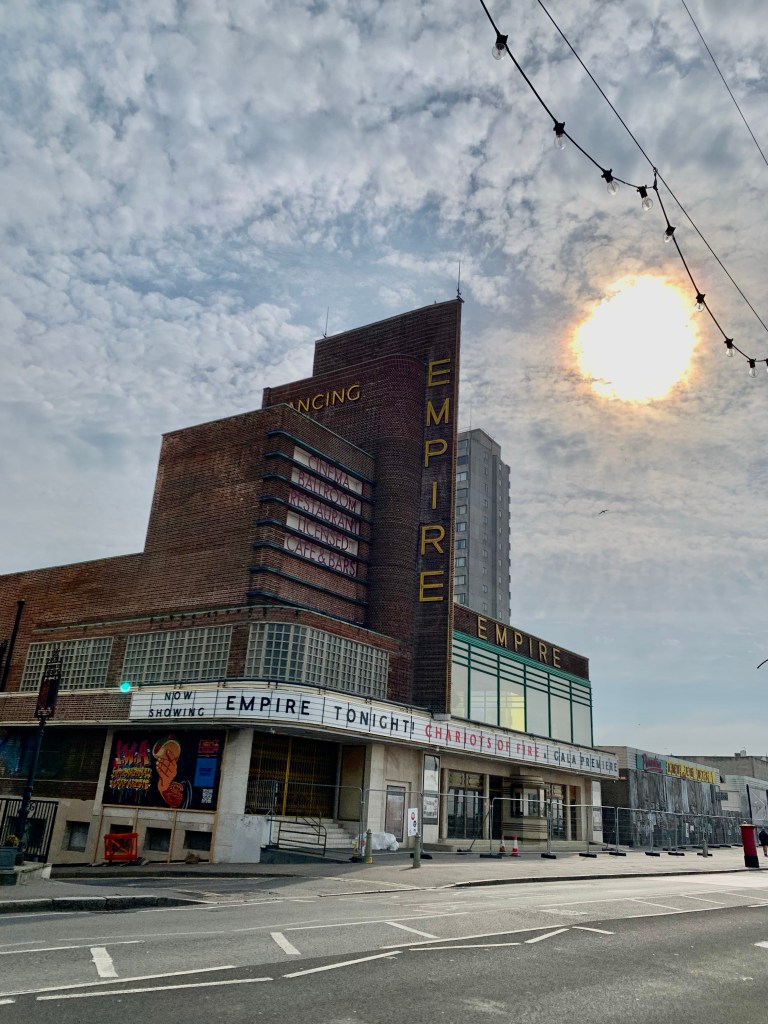
The hospital scene was filmed on a set built at Ramsgate airport, but there was a couple of other scenes I was called for that were filmed in Margate. The first was in a cinema on the seafront built to capture the 80s aesthetic. It was classic art deco, with impressive Grecian pillars and marbled stairways, and the red curtains that were typical of theatres of the day. Many of us extras were paired up as couples going on a date night to the cinema, others were grouped into friends, and there were some older extras who sat alone. The props team even handed us the classic popcorn buckets, which were refilled with Sainsbury’s popcorn after every take. The scene we watched was a scene from the 1980 comedy film Stir Crazy starring Gene Wilder and Richard Pryor. By the time we wrapped, we all knew every detail of that scene start to finish. Needless to say, watching a film in a cinema as an extra for a film was probably one of the most meta things I’ve ever done.

The other scene was shot right in the heart of Margate’s Dreamland; a recently reopened fairground with rides, arcades, and a roller disco. This was the most enjoyable scene I participated in. The scene they were filming was a living, breathing fairground. There were extras on rides, running fairground stalls, and real ice cream and candy floss stalls. It was a busy scene with a lot of extras present; from groups of intimidating skinheads smoking to families and school children on a day out (At my extra ‘interview’ I was asked if I would be willing to have my head shaved and smoke – I politely declined both!). Despite the large scale of the set, it was the closest I’d been to the main actors. One scene even involved Olivia Coleman and Micheal Ward going around a spinning ride, which made me think acting must be one of the best jobs ever. I was assigned to run a coconut shy in the background of one scene; with an army of 80s school kids ruthlessly smashing coconuts in between takes. At one point one of the youngest extras got upset because he didn’t win a prize on a stall as it wasn’t real: the wonderful Olivia Colman stepped and picked out a prize for him herself. There was such a positive energy on set that day. The sun was shining, the rides were rolling, and I don’t think I’ll ever get through so much candy floss in one day.

Being an extra on such a major movie was a unique and exciting experience. If the opportunity arises, I would recommend it to anyone who is interested in filmmaking or films in general. The job requires a lot of patience, as you spend long days waiting around to be called, or even wondering if you’ll be called at all. Regardless of whether your scene is in the final cut, being able to observe the film-making process first hand is a valuable and rewarding experience, and one that has only expanded my passion for cinema. It has forever changed my perspective on the process of movie production, and I would certainly be up for getting paid for lying in a fake hospital bed again reading a Star Wars magazine in the future (and yes, you can spot me in the final cut!).

Watch Empire of Light in cinemas from 9th January.

The fictitious cinema ‘Empire’ created at Dreamland on the Margate seafront, taken when I went for a costume fitting