
Asa Butterfield is on his own. He sits on a chair on the stage of Studio 2 at Riverside Studios in London. He occasionally gets up to wander around and pass reflective glances at the audience shuffling into their seats. What follows is a story about missed opportunities, fate and family, told solely by Butterfield and strangely revolving around Harry Potter…
Second Best is the fictitious story of Martin Hill, a man, who at 10 years old, was one of the two final contenders to play Harry Potter. Based on a novel of the same name written by David Foenkinos, the one-man play is effectively an uninterrupted monologue of Martin Hill telling the story of his life and the knock-on effect missing out on the role of a lifetime had. Definitely one of the most unique plays I’ve ever seen, not only does it begin with Butterfield already on stage, he continues to be present for the entire duration of the play. Arguably one of the most famous British child actors of this generation, popping up in series’ such as BBC’s Merlin (2008) and Ashes to Ashes (2008), and films like The Wolfman (2010), and Nanny McPhee Returns (2010). Until he received wider recognition for The Boy in the Striped Pyjamas (2008) and Martin Scorsese’s endeavour into the family genre in Hugo (2011). Of course, most young adults will most likely know Butterfield as Otis Milburn from Netflix’s Sex Education.
Arguably dissimilar to his screen work, Second Best allows Butterfield to express his full acting range, from the humorously endearing awkwardness of Otis Milburn to much more poignant, tense emotional moments that the play requires. His exceptional ability to express this range gives the play an undeniable bittersweet feeling. For the most part, it is exceptionally funny, and Butterfield’s comedic timing in the stories he tells land excellently with the audience. However, there are times in the play which deal with loss; not only losing the role of a lifetime, but the loss of family and of one’s sense of self. Butterfield portrays such moments with unexpected sensitivity, evoking great sympathy for Martin Hill and reminds us how easy yet dangerous it is to reflect on what could’ve been.
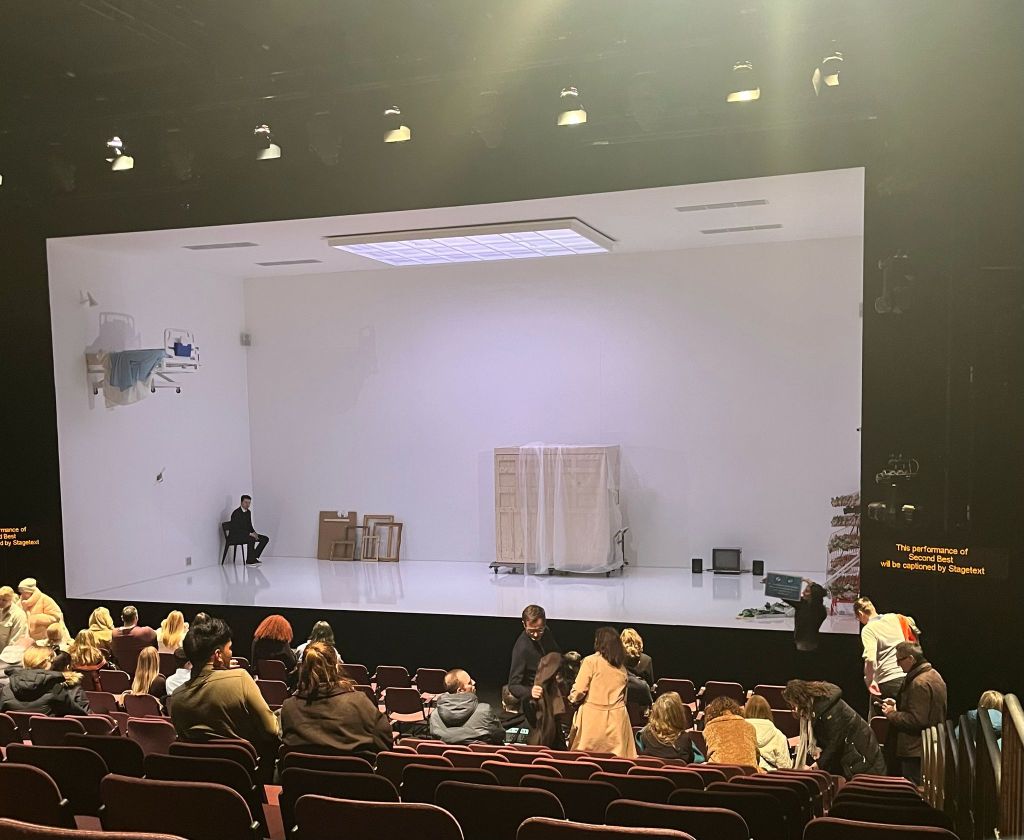
The stage itself is also very uniquely designed and arranged to reflect the play’s bittersweetness. It is a white room with various seemingly random objects scattered around. From corner shop crisp shelves to a hospital bed affixed high up on the wall, these objects are the only other actors on stage with Butterfield. They act as visual accompaniments to Butterfield’s storytelling, giving the play a personal touch of the things we associate with certain memories and feelings. Moreover, there is a wardrobe from which Butterfield retrieves certain costumes and props, with some hilarious nods to Harry Potter itself. Second Best pokes fun at Harry Potter; the inescapable scale of a global phenomenon and the use of certain terms and phrases to create some admirable irony.
Solely the fact that Butterfield’s stage debut was a one-man play is impressive, but the range he provides in his performance makes it even more so. It was truly wonderful to see a British actor who popped up so frequently in my adolescence and whose roles had some personal resonance with perform on stage. I do hope the reception Second Best has received encourages Butterfield to pursue further theatre endeavours, as he has clearly made the transition from screen to stage with exceptional grace. Second Best was one of the most uniquely funny yet poignant plays I’ve seen, and it is a play I would recommend to anyone who enjoys something different on stage, is an Asa Butterfield fan, or simply even a Harry Potter fan.
 G does Films