From hot tea to hospital sets: My experience being a film extra in Sam Mendes’ new film, Empire of Light

May 4th is known to many as International Star Wars day (‘May the 4th be with you’). I could never have imagined that I would be spending Star Wars day reading an article about The Empire Strikes Back in a 1980s-hospital ward. On May 4th 2022, I lay in a hospital bed with an intravenous drip taped to my arm reading an original magazine from the film’s release year in 1980. Before you wonder whether I had stumbled into some sort of Tardis, I was in fact on a film set, which to me is quite possibly the next best thing to time-travel. Everything from the 1980s style Cadbury’s Roses box on my bedside table, to the doctor and patient costumes worn by my fellow extras, the film-makers had considered every detail in setting of the scene.

The film was James Bond director Sam Mendes’ Empire of Light, a romantic story drawing on the director’s childhood experiences of cinema and starring Olivia Colman and Micheal Ward. I was called in at the crack of dawn for the hospital scene, but cameras didn’t roll until around 2 pm. I kept myself occupied by reading books, catching up with uni work, and chatting to fellow extras. It was a rewarding way to meet people who share an interest in film, and make contacts for potential future projects. Hanging out with like-minded people for long periods waiting for a call to the set forges friendships surprisingly quickly. Sitting around in 1980s attire with 21st century iPhones and overcoats provided a curious juxtaposition of different eras. The large team of extras were well looked after. I was pleasantly surprised by the food served by the on-set catering team too. The menu differed each day, and provided a variety of different dishes along with a plethora of beverages, desserts and cheese and biscuits (on my filming day I went for spinach and feta cheese quesadillas which were delicious). I also found myself drinking excessive amounts of tea; whether it was to maintain the caffeine boost from the early starts or simply pass the time – not even I could be sure.

In the two places I had my fitting and shot the scene there were plenty of noticeable indicators of the film’s setting. There were rows of late 70s and 80s Fords and Vauxhalls, and even some police cars and ambulances from the same time period. When I was on set the day before filming, there was a close-up scene being filmed in the back of an ambulance – indicated by the 1980 model with its back doors open surrounded by black screens, lights and crew members. Then of course, there were the costumes. At the fitting, there were rows and rows of 70s/80s fashion, in addition to various different patient, nurse and doctor’s outfits. My patient attire consisted of one of the more basic outfits, simply being a light green button-up shirt and bottoms over some white tights; which I could best describe as some fancy retro pyjamas. The walls were adorned with pictures of real photos of 70/80s outfits and haircuts, clearly a reference guide for those working in the costume, hair and make-up department. In fact, I was required to get my long hair trimmed as part of the role. A lovely Welsh hairdresser gave me a bob of sorts – utilising my inherited curls. At first I thought it looked like the Beatles‘ signature haircut from the early 60s, but when it was ruffled up for the role it was more akin to David Naughton’s hair in American Werewolf in London (a film released in 1981; the same year Empire of Light is set in). It wasn’t until I was actually on the hospital set for the film that the detail devoted to the set really sank in. As I sat ‘ill’ in my bed, I admired the work put in by the set designers, costume team, and the props guys who had put together a very authentic looking ward. At one point I was required to silently ‘mime’ a conversation with a doctor in the background of one of the takes. It was fascinating to see the cinematographers and mic operators in their element, adjusting every position and angle so they got each take just right. Sam Mendes himself even approached my bed at one point to adjust a table lamp. There were many people running and back and forth on the set; people shouting ‘rolling’ and ‘action’ every 5 minutes, designers adjusting extra’s hair and makeup, stand-ins for the main actors, and of course, the main actors themselves. It’s a surreal experience working alongside well-known actors who are so greatly admired. As much as you’re aware they are regular people doing a job, it is impossible not to become star-struck when they walk on set. I did however get a smile or two from Olivia Coleman.

The hospital scene was filmed on a set built at Ramsgate airport, but there was a couple of other scenes I was called for that were filmed in Margate. The first was in a cinema on the seafront built to capture the 80s aesthetic. It was classic art deco, with impressive Grecian pillars and marbled stairways, and the red curtains that were typical of theatres of the day. Many of us extras were paired up as couples going on a date night to the cinema, others were grouped into friends, and there were some older extras who sat alone. The props team even handed us the classic popcorn buckets, which were refilled with Sainsbury’s popcorn after every take. The scene we watched was a scene from the 1980 comedy film Stir Crazy starring Gene Wilder and Richard Pryor. By the time we wrapped, we all knew every detail of that scene start to finish. Needless to say, watching a film in a cinema as an extra for a film was probably one of the most meta things I’ve ever done.

The other scene was shot right in the heart of Margate’s Dreamland; a recently reopened fairground with rides, arcades, and a roller disco. This was the most enjoyable scene I participated in. The scene they were filming was a living, breathing fairground. There were extras on rides, running fairground stalls, and real ice cream and candy floss stalls. It was a busy scene with a lot of extras present; from groups of intimidating skinheads smoking to families and school children on a day out (At my extra ‘interview’ I was asked if I would be willing to have my head shaved and smoke – I politely declined both!). Despite the large scale of the set, it was the closest I’d been to the main actors. One scene even involved Olivia Coleman and Micheal Ward going around a spinning ride, which made me think acting must be one of the best jobs ever. I was assigned to run a coconut shy in the background of one scene; with an army of 80s school kids ruthlessly smashing coconuts in between takes. At one point one of the youngest extras got upset because he didn’t win a prize on a stall as it wasn’t real: the wonderful Olivia Colman stepped and picked out a prize for him herself. There was such a positive energy on set that day. The sun was shining, the rides were rolling, and I don’t think I’ll ever get through so much candy floss in one day.

Being an extra on such a major movie was a unique and exciting experience. If the opportunity arises, I would recommend it to anyone who is interested in filmmaking or films in general. The job requires a lot of patience, as you spend long days waiting around to be called, or even wondering if you’ll be called at all. Regardless of whether your scene is in the final cut, being able to observe the film-making process first hand is a valuable and rewarding experience, and one that has only expanded my passion for cinema. It has forever changed my perspective on the process of movie production, and I would certainly be up for getting paid for lying in a fake hospital bed again reading a Star Wars magazine in the future (and yes, you can spot me in the final cut!).

Watch Empire of Light in cinemas from 9th January.
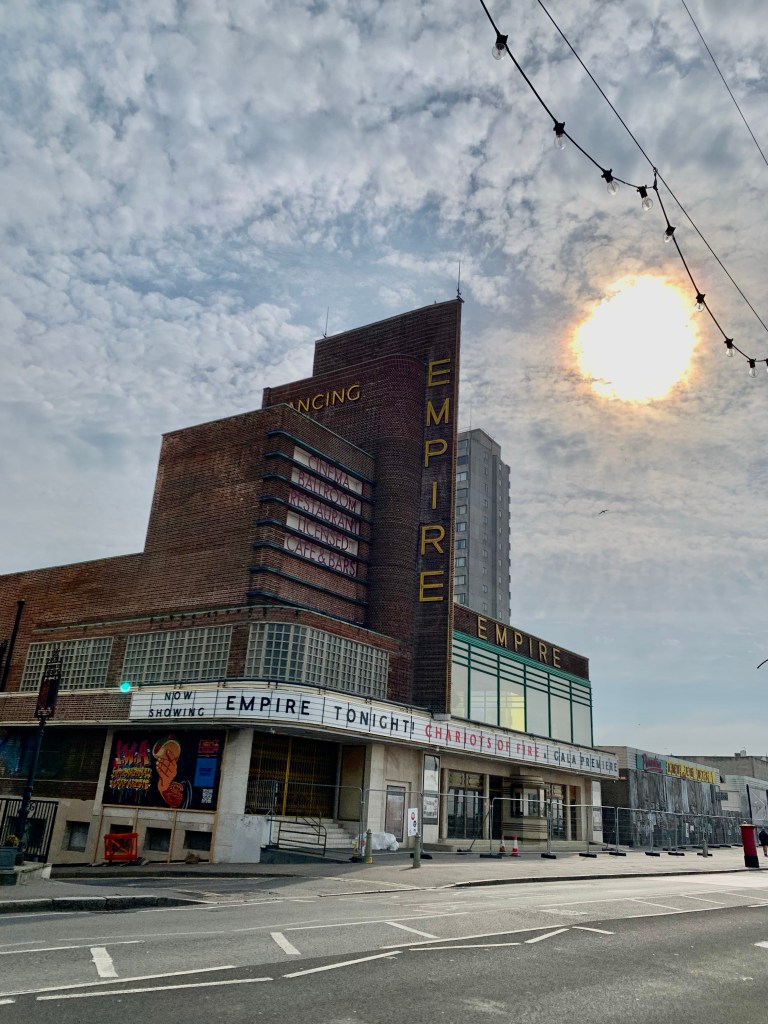
The fictitious cinema ‘Empire’ created at Dreamland on the Margate seafront, taken when I went for a costume fitting

‘The Northman’ review: An epic tale of vikings, valour and vengeance

I don’t think the word ‘Viking’ is uttered once in the entirety of The Northman. This appropriately epitomises the authentic Norse feel of the film, as you don’t always need words to convey a feeling in filmmaking. Director Robert Eggers absorbs us in a brutal yet ancient world which runs red with the blood of fathers and sons, overseen by the Norse all-father God Odin. In typical Eggers style, the film blends the real world with the supernatural, using tight cinematography and ominous lighting to create an other-worldly feel to a period of real history. Eggers and Icelandic writer Sjón tell a tale which runs a thin line between valour and vengeance, and how following one’s fate isn’t always as straightforward as it seems. In a world filled with axes, gods, and the threads of fate, good and evil doesn’t exist; it is simply whoever plunges the sword in first.

The Northman follows Viking prince Amleth (Alexander Skarsgård) as he sets off on a path to avenge the death of his father, King Aurvandill (Ethan Hawke). The plot is based on the medieval Scandinavian legend which inspired Shakespeare’s Hamlet, which is very evident in the film’s story and performances. Every member of the cast give Shakespearean-esque performances, expressing raw emotion when needed and blending English with ancient Nordic tongues, which only adds to the other-worldly feel. Skarsgård gives a furious yet empathetic performance as Amleth; providing us with the raw, animalistic rage of a vengeful Viking, but also showing us he’s not completely unrelenting or heartless in the right moments. Anya Taylor-Joy is also a highlight, portraying Amleth’s love interest and Slavic sorceress Olga with supernatural charm, proving yet again her versatility in historical roles. Willem Dafoe was also a pleasant surprise to the cast, playing King Aurvandill’s fool in what would quite possibly be Dafoe’s ideal career if he lived in a Viking world. Ethan Hawke and Claes Bang’s performances as King Aurvandil and Fjölnir respectively also add to the authenticity of the world, and give modern day audiences an idea of how much Vikings valued bloodlines and vengeance.

The Northman also gave us with what is probably my favourite film score of 2022 so far. First-time film composers Robin Carolan and Sebastian Gainsborough experimented with ancient instruments to perfectly capture the scale of the world Amleth journeys through. From the resounding horns expressing the grandeur of Viking Norway and Iceland, to the atonal, sporadic strings conveying that unnerving atmosphere which has become so synonymous with Eggers’ supernatural style. Along with the soundtrack, the immense production design of the film helps capture the essence of the time period. The beautiful Icelandic landscapes make for some stunning cinematography, and the impeccably unclean and rough costume design give us sense of historical authenticity which I have the upmost appreciation for in these types of films. There’s even some sequences of what can only be described as recreations of traditional Viking rituals. Their ridiculousness by today’s standards is compensated by the fact that not many films would go that far in capturing the authenticity of the time. Only in a film like The Northman could a scene of a group of filthy Norse men dancing around a fire pretending to be wolves be so satisfying. The action sequences are slick and bloody as they should be, often consisting of satisfyingly long takes but never too gratuitous. There’s even a game of ‘Knattleikr’ which is like Viking hockey except much more brutal and appropriately violent as it would’ve been back then. As for the film’s supernatural elements, to the casual viewer they may seem slightly jarring at first, but similarly to Eggers’ other films, it elevates the genre just enough to make it unique and interesting. Eggers adds a supernatural element to his films to give modern day audiences a taste of the folklore of the time, and what makes it so effective is how realistically it’s portrayed. It’s never too much that it makes the world feel unrealistic, but never too little that it makes it unbelievable.

The Northman is one of those historical films that transports us back to a time in our world, but a time so long ago that it feels like a different world. It tells a revenge story not unlike others, but one fuelled by Viking rage and sprinkled with Norse mythology. It shows us that even in Viking times, our deeds aren’t always as simple as good and evil, but are better described as a matter of perspective. Amleth is presented as the protagonist, but commits violent atrocities for the sake of valour for his bloodline. Fjölnir is presented as the antagonist, but has moments of genuine sympathy and compassion for those around him. It is a story much like Shakespeare’s tales of old, that of a conflict between compassion for those you love and vengeance for those you hate, and how far one is willing to go to pursue one or the other. The film is long, dark and bloody, so it may not be for everyone, but those who are willing to divulge into some visceral Norse history for two and a half hours may find something special. The historical authenticity and brutal nature of The Northman, topped with the supernatural sprinkles of Norse mythology, makes it undoubtedly my favourite Robert Eggers film so far. It makes me want to pick up and axe and angrily chop up some wood (not bodies) whilst howling like Fenrir the Norse wolf. I’m very much looking forward to the next time period Eggers decides to tackle in a film. I have no doubt he has enough potential to make even the 1990s seem supernatural yet retain their realism. Here’s to a spooky yet sparkly take on PCs and the World Wide Web. Skal!

‘The Batman’ is everything Batman should be and more

Ever since the dawn of cinema, filmmakers have continually utilised the power of using ‘the’ in their film titles. Especially in horror, films such as The Shining, The Thing, The Exorcist, The Birds, all use ‘The’ in their titles to creating an ominous feeling of dread; something that overshadows everything and incites fear of the subject in the title. A simple but effective technique which director Matt Reeves uses in his new take on Batman. This film encompasses the title of ‘The Batman‘ by creating a dark, gritty Gotham city in which there lurks a force to be reckoned with. A force whose past trauma has led him to practically abandon his every day life and dedicate himself to a symbol. A symbol which targets Gotham’s corrupt and strikes fear into the hearts of criminals. This symbol is – The Batman.

Everything about this film encompasses what it means to be Batman. From Michael Giacchino’s chilling yet epic new Batman theme, to the stunning wide shots of Gotham’s skyline at dawn. The film provides not only a fresh take on the caped crusader himself, but also the storyline and world he is placed in. In The Batman, the titular character must follow a murderous trail left by the Riddler whilst becoming entangled with a variety of other characters such as Selina Kyle and ‘Penguin’. The Gotham City in The Batman felt more dirty and unkept than any other iteration so far, which is exactly the type of setting such dark characters would believably spawn from. It feels like a city run by it’s criminals who are haunted by a vengeful vigilante known only as ‘The Batman’. The scene in which you first see Batman himself genuinely felt like something out of a horror film. The way the camera shots linger when he is on screen and the colours of the scene around him only add to his intimidation and how he is truly perceived as a monster by criminals. Interestingly, the film focuses on Bruce Wayne’s fractured psyche, as Reeves practically abandons Bruce Wayne’s playboy billionaire persona and instead presents a more unnerving, unhinged Batman, and a much more antisocial, reclusive Bruce Wayne. Both Robert Pattinson’s Batman and Bruce Wayne are men of few words, mostly keeping their human interactions minimal as they learn to traverse their way through Gotham’s criminal underbelly. Even Wayne Manor looks more like Dracula’s castle than the abode of a playboy billionaire, and I appreciated one moment in particular which showed how Bruce Wayne doesn’t tend to go out during the day.

The film also shows off an excellent variety of supporting characters. Every scene with Paul Dano’s Riddler was chilling, and left the cinema in absolute silence. Dano effectively managed to balance the unnerving campiness of the classic Batman villain whilst adding an almost serial killer eeriness. This really suited not only the setting of the film, but also gave a realistic portrayal of the characters as if he was a real person in the 21st century. Zoë Kravitz’s Selina Kyle was also a blend of the classic character with a realistically updated portrayal. She almost acted as Batman’s darker side (as if he could even have one), more at the mercy of her base impulses yet rooted from similar trauma to the caped crusader himself. As such, her relationship with Batman was one of the most intriguing aspects of the film; going from two self-serving individuals who happen to cross paths to two people whose shared trauma and reclusiveness naturally draw them towards each other. The other supporting cast members only helped to encapsulate the unclean feeling of Gotham City in the film. Jeffery Wright’s Jim Gordon makes you feel as if he has the entire weight of the Gotham police on his shoulders. He is constantly being told not to associate with the vigilante, yet he still knows full well that the Batman may be the only one capable of stopping the Riddler. Colin Farrell’s portrayal of Penguin was also more of a realistic mobster than the classic bird-brained villain. The use of prosthetics to make Colin Farrell almost unrecognisable made the character look like a real mobster who would plague the criminal underworld, which I really appreciated.

DC comics have really struggled to find their footing in cinema over the past decade. The company went from creating an extended universe of films to standalone films as we started to lose count of how many times we’d seen Bruce Wayne’s parents get shot on screen. Nonetheless, it is good to see such an iconic character receive the modern day treatment he deserves. I understand this iteration of the character may not be for everyone, since the film is quite slow and deliberate with a 3-hour runtime. On the other hand, in a world full of face-paced, energetic superhero films, it’s nice to have something which takes its time and has clear thought put into its characters and plot. The Batman reminded me a lot of the final season of Marvel’s Daredevil series. It shows how loss and trauma manifests itself into vigilantism; how a man can take every possible measure to overcome it and prevent anyone else from having the same experience. By doing this, they may isolate from society and become dedicated to an ideal bigger than themselves; which is reflected not only in the Batman, but in the Riddler too. The Batman is a classic comic book tale of one man fighting not only a battle against crime, but a battle within himself. The film left me very hopeful at the prospect of seeing more of Pattinson’s Batman in Reeves’s gritty iteration of Gotham City.

Robert is that you?

Spider-Man: No Way Home is a love letter to everything Spidey

The day was Wednesday 15th December, 2021. The time was approximately 21:42. A young man had just walked out of one of the first screenings of Spider-Man: No Way Home. This young man had been a Spidey fan ever since he was a young boy climbing in trees and collecting Spider-Man figures from Sam Raimi’s Spider-Man trilogy. He had been there for every new Spider-Man film for as long as he could remember, and was very well informed on the comic book origins and timeline of the web-slinger. He knew that what it meant to be Spider-Man was not to have the proportionate strength, speed and ability of a spider. He knew what it meant to be Spider-Man was Peter Parker. A young man, a similar age to himself, who suffered and lost what he held most dearly as he battled between his life as a masked vigilante and a broke but clever student from New York City. On that particular Wednesday, the young man had never been in such awe of the web-slinger who had held such a close place in his heart ever since he was a young boy. That young man, was yours truly.

Spider-Man: No Way Home is a triumphant love letter to everything which makes Spider-Man, Spider-Man. It not only has its much needed doses of fan service, but it is quite possibly the best Spider-Man story to be portrayed on the big screen. The main cast gives it their A-game, from Tom Holland as the titular hero to Alfred Molina reprising his role as Doctor Octopus. For those skeptics who saw Tom’s Spider-Man as nothing more than Tony Stark’s golden teenager, No Way Home proves that Tom can in fact encompass what it means to be Spider-Man, which quite possibly makes him the best iteration of the character to date. He goes through things in the film which no previous Spider-Man has gone through before, yet they are experiences which ultimately defines what it means to be Spider-Man. The film not only changes the course of the Marvel Cinematic Universe, but also the course of the story of Spider-Man on the big screen. It is in a sense the Avengers: Endgame equivalent for Spider-Man. The stakes have never been higher, and the addition of Benedict Cumberbatch’s Doctor Strange adds for some intense multi-versal elements we have not yet seen on the big screen in the MCU. The fight scene between Spider-Man and Doctor Strange is impressive enough to rival Strange’s spectacular battle with Thanos in Avengers: Infinity War. Taking inspiration from one of the most controversial Spider-Man stories in the comics, ‘Spider-Man: One More Day‘, the film places some MCU twists on the comic storyline whilst still remaining relatively true to the source material. It was brilliant to see so many iconic Spidey villains on-screen together in live action, giving us what is essentially the closest version of a live-action Sinister Six (even though there wasn’t quite six). It is often difficult to have so many supporting characters on-screen without making a film feel crowded, but No Way Home somehow does it perfectly. The villains’ chemistry with not only Spider-Man, but also each other, was one of the best aspects of the film which I was pleasantly surprised by. I genuinely could not stop myself from grinning all the way through the film, it made me feel so lucky to be a film fan, a Marvel fan, but most of all, a Spider-Man fan.

I would be interested to watch this film from the perspective of a non-Marvel or Spider-Man fan, as I have no doubt there is still much enjoyment to be found. To the casual cinema-goer, Spider-Man: No Way Home is nothing short of the story of a young boy becoming a young man. It is a story of how far a person is willing to go to do the right thing. It is a story of an average teenager attempting to balance his normal life with the responsibility of being a superhero, which is exactly what Spider-Man is all about. The film shows that no matter how much loss and suffering Peter Parker goes through he is still willing to make sacrifices to do the right thing, which is exactly why we love him. Any doubt about Tom’s iteration of Spider-Man is gone by the end of the film. He truly epitomises what it means to be Spider-Man and Peter Parker, and the film makes it clear that the person who does the right thing is not Spider-Man, but Peter Parker.

Stay tuned for a spoiler-filled blog…

Just hanging around…

How Ghostbusters: Afterlife is fan service done right

Fan service is a hard thing to nail. When dealing with a beloved classic like 1984’s Ghostbusters, there’s a very thin line between using fan service just to make a movie good and encapsulating the nostalgia which made the original such a cultural phenomenon. 2016’s Ghostbusters directed by Paul Feig undoubtedly leans more into the latter than the former. It focuses too much on attempting to pander for fans of the original than creating an original story which pays appropriate homage to the original when necessary. This year’s Ghostbusters: Afterlife however is a triumphant love letter for fans of the original. It provides an engaging original story with new, likeable characters, and provides appropriate plot links to the 1984 original rather than bombarding the audience with pure fan service.

Ghostbusters: Afterlife takes place 32 years after the events of Ghostbusters II, effectively acting as a ‘Ghostbusters III’. It follows single mother Callie (Carrie Coon) and her two children Trevor (Finn Wolfhard) and Phoebe (McKenna Grace) as they move into an old house in a small town in rural America with an unusual link to the original Ghostbusters. The film is of course littered with references to the original, but unlike the 2016 Ghostbusters film, they’re actually more relevant to the story and feel ‘earned’ in a sense. It is directed by Jason Reitman, the son of the original director Ivan Reitman. Interestingly there’s a few horror elements thrown into Afterlife which perhaps distinguishes the directorial style between father and son, as the original focused primarily on comedy. Nevertheless, the laughs of Afterlife consist of McKenna Grace’s endearingly dry dad jokes, Podcast’s (Logan Kim) running commentary on the supernatural events, and of course Paul Rudd being Paul Rudd. As soon as I heard they were doing a new Ghostbusters film featuring Paul Rudd and Finn Wolfhard – I was in.

Interestingly I only watched the original Ghostbusters for the first time a couple of years ago, so I wouldn’t have experienced the same level of nostalgic throwback watching Afterlife than some of the OG fans. The original is such a loveably unique film, and I could appreciate how Bill Murray, Dan Aykroyd, Harold Ramis and Ernie Hudson made it an instant cult classic. The 70s and 80s gave rise to several of the classic supernatural horror films such as The Exorcist and Poltergeist. So naturally a film about about a group of paranormal enthusiasts forming what was effectively a ghost pest control service was probably exactly what audiences needed. Also, I can’t write about Ghostbusters without mentioning Rick Moranis. I think he quite possibly makes not only the first film for me, but also the 1989 sequel. For me, Ghostbusters took a very fearfully daunting concept and made it something audiences could laugh at. It showed that even the darkest concepts can be made light of, and that what we perceive as scary is very often determined by Hollywood and pop culture. Now whenever a supernatural film freaks me out to the point where I’m paranoid over the smallest sounds during the night, I just think of Rick Moranis walking out of the NYC firehouse in his Ghostbuster get-up to the sound of Ray Parker Jr’s titular track.

In a world where reboots, remakes and re-imaginings are abundant in cinema, it was nice to have what felt like a legitimate follow-up to a cult classic. I recently wrote about the latest edition to the Halloween franchise, Halloween Kills, in a previous blog, which similarly acts as a direct follow-up to the original decades later and also pays appropriate homage when due. Revitalising a classic franchise by producing a sequel set decades later in real time has become more and more common in the past decade or so. There are many examples of this which have done what I have come to refer to as ‘Force Awakening‘ a franchise; including Jurassic World, Tron, Star Wars of course, and the upcoming Matrix: Resurrections. Whilst I think this is generally the right way to go about revitalising beloved classics, it is a very tricky thing to do right, not only by the franchise but by simply producing an enjoyable film in its own right. Providing a modern day perspective on events of a classic can provide new generations of audiences (such as yours truly) with an appreciation for the by-gone ages of cinema. It is for these reasons I believe that Ghostbusters: Afterlife is a fan service film done right. It nails the nostalgia without pandering too much for the fans, and provides an entertaining new story for old and new generations of audiences. There are also some surprises along the way which I was not expecting, and are undoubtedly best experienced by watching the film first-hand.