The company of ‘Playing Shakespeare with Deutsche Bank: Romeo and Juliet’ want you to know it isn’t a run-of-the-mill Shakespeare production. There’s graffiti on the walls of Shakespeare’s Globe, a mini skatepark in the centre of the yard, murals to victims of knife crime, and the beginning of the play is signified by a masked hoodlum lurking through the audience on a BMX. Knife crime is not something you’d expect to be so intricately woven into Shakespeare’s most iconic love story. However, when watching a fast-paced, 90-minute adaption set in modern day, it is in fact one of the play’s most integral themes.
Adapting one of Shakespeare’s most well-known plays for a younger, modern day audience is arguably a challenge, but theatre director Lucy Cuthbertson did so with exceptional grace. At a tight 90-minute runtime (the original being over 2 hours), this adaption clearly intended to fully engage its audience and maintain their attention until the tragic end. Not only do the actors constantly interact with audience members, the language maintains its Shakespearean integrity whilst being engaging for a modern audience. Spoken as if it were written today, and delivered by an exceptionally charismatic cast.
The titular characters were played by Hayden Mampasi and Felixe Forde, respectively, whose chemistry made them the most easily likeable characters in a cast of intimidating-looking supporting characters. One of the play’s highlights being the balcony scene – Mampasi standing amid the audience, addressing a smitten Forde leaning out over the Globe’s balcony. Ashley Byam’s performance as Mercutio was also a highlight – a combination of the loveable flamboyance of Ncuti Gatwa’s Eric from Netflix’s Sex Education and Harold Perrineau’s own Mercutio from Baz Luhrmann’s endearing 1996 adaption; Romeo + Juliet.
The action on stage was backed by a trio of percussionists on the back of the stage balcony (Rosie Bergonzi, Zands Duggan and Dave Price), notably so in the Montague and Capulet party scene. The big band-style drumming and percussion made some scenes in the play almost like a musical – the entire cast dancing in sequence which resulted in a rapturous applause. One dance sequence in particular was presented as a hallucination after Juliet drinks the potion. The cast came out dressed as if they were in Mamma Mia! and Simeon Desvignes’ Paris stripped down in the most out-of-pocket scene I’d seen in a Shakespeare play. I understood the appeal intended for a younger audience, but it made me feel as if it took that appeal a little too seriously, which compromised the tone of the scene.
Playing Shakespeare with Deutsche Bank: Romeo and Juliet promised a great introduction to Shakespeare for younger audiences, which I believe it delivered. The performances are engaging enough to keep anyone invested even when the action is minimal and it is simply two characters having a conversation. The choice to set the play in modern South London made it not only easily accessible for today’s younger audience, but also reminded us how resonant its messages still are today. It uses its intricate plot about love spawning from hate to deliver poignant messages about knife crime and gang violence. It is here where this adaption truly shined, and yet again showed why Shakespeare’s work will remain indefinitely exceptional.
Shakespeare’s Globe dressed for a South London version of the bard’s classic love story.
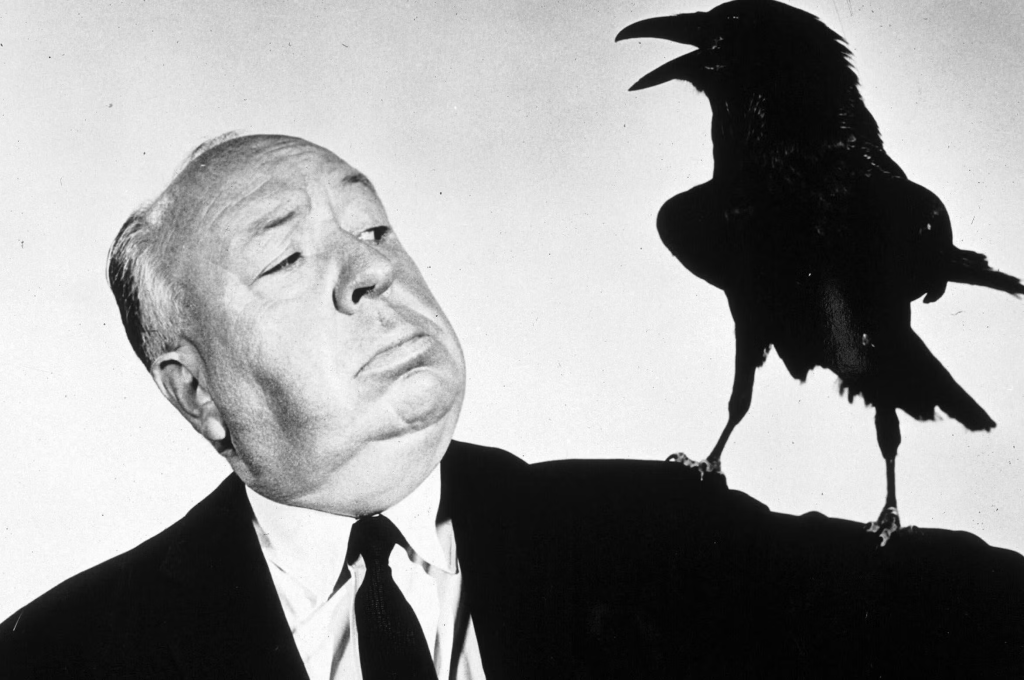
As a shameless ‘film bro’ and an avid horror fan, I felt like it was my duty to experience the work of a man who is often regarded as one of the greatest filmmakers in history. I’m referring to, of course, the ‘master of suspense’ Alfred Hitchcock. I got hold of a boxset of four of his most highly regarded films; Rear Window (1954), Vertigo (1958), Psycho (1960), and The Birds (1963). I watched them over the course of a week with my dad in release order, and, since it was Hitchcock, I thought I would do what I do best with movies – get all my thoughts out on this blog. What did I think? Did I enjoy them? Do they still hold up 60+ years later? Do I finally understand why Hitchcock is regarded as one of the greatest filmmakers and as the ‘master of suspense’? Read on and I will leave you in suspense no more…
First up was Hitchcock’s 1954 murder mystery Rear Window. It follows photographer L.B. ‘Jeff’ Jeffries (James Stewart) as he is confined to his apartment by a broken leg, with nothing better to do than spy on the neighbours across his Greenwich village courtyard. His spying takes a turn when he begins to suspect one of the neighbours has murdered his wife, and so Jeff enlists the help of his girlfriend Lisa (Grace Kelly) and nurse Stella (Thelma Ritter) to solve the mystery. What impressed me about this film was that the story unfolded almost entirely through Jeff’s apartment window through the perspective of his binoculars. What made this even more impressive was the detail that was put into constructing the elaborate set for the courtyard. It took six weeks to build, complete with lighting to accommodate both day and night sequences, and even included a drainage system for one rain sequence in the film. It was apparently the largest set built at Paramount studios at the time. It has a slow start, as the film is set in the same apartment, with the same shots, centred around the same three characters, yet it somehow still immerses the viewer in the narrative. The film confines you to Jeff’s wheelchair as he attempts to solve the murder mystery which makes it all the more gripping, and the last 20 minutes especially tense. There are certain shots in this film that are haunting and will remain with me for a long time.
Next was Vertigo, which if made today, would almost certainly be directed by Christopher Nolan. It is arguably Hitchcock’s most technically ambitious film, as it uses some unconventional special effects and is the first film to use the dolly zoom (when a camera zooms into a subject whilst physically moving away, distorting the background). The film follows former detective John ‘Scottie’ Ferguson (James Stewart once again) who has been hired as a personal investigator by Gavin Elster (Tom Helmore) to follow Elster’s wife Madeleine (Kim Novak). The elaborate plot of the film hinges on Scottie’s extreme fear of heights that stemmed from a traumatic experience earlier in his career. Despite the name, it doesn’t portray the condition of vertigo, but the dolly zoom is used to good effect to represent Scottie’s fear of heights. The plot is interestingly constructed, and the way Scottie’s fear is portrayed and weaved in throughout is very Nolan-esque. There’s some exceptional camera work which sells Scottie’s condition, and there’s one particular dream sequence which is the pinnacle of 1950s movie effects, and appears rather out of pocket compared to the rest of the film. My main issue with this film is that it is the archetype slow burner. Granted, it’s of the time, but the pace remains the same up until the last 20 minutes. At which point there is a significant plot twist which somewhat pays off the rest of the film, but generally the pacing is something you’ll have to bear with to appreciate the film fully. Still, there’s some tense moments and I can understand why it receives the praise it does. I always find it hilarious how terribly awkward love making scenes are in old movies. The actors look as if they have been given strict direction to underplay the passion.
Next was not only Hitchcock’s most iconic film, but one of the most iconic films of all time. What can I say about 1960’s Psycho that hasn’t already been said? It stars Vera Miles as Marion Crane who ends up at the notorious Bates Motel, where manager Norman Bates (Anthony Perkins) seemingly cares for his housebound mother. What follows reset the genre for horror, suspense, and even gore. This was the slasher before slashers, simply because it’s more suspense than actual slashing. I have no doubt the gore in this film back then was the equivalent to Saw now. The difference is, the violence in this film hits harder not because of the violence itself, but the care that Hitchcock put into creating a suspenseful build up. The reason this film is so timeless is because of how simple yet effective horror filmmaking is. Something as simple as a slow camera pan or a musical cue can create gripping tension when well executed. Bernard Herrmann’s iconic score is perfectly chilling, and provided the cookie cutter for horror movie and suspenseful scores to come. Anthony Perkins was exceptional as Norman Bates, from his awkward mannerisms and stutter to that psychotic stare at the end. His performance is like something you’d see in a film today, which is exactly why it still holds up. Granted, this film has its slow and duller moments and some of the dialogue is rather stilted but it’s not enough to break up the experience. This film also has one of the most memorable and chilling ends to a film I’ve ever seen…that smile.
Finally came 1963’s The Birds. Having only just watched Psycho a few days prior, I couldn’t help but think it was more than a coincidence that Norman Bates had a fascination with taxidermy birds prior to Hitchcock making a film called ‘The Birds’. The Birds stars Tippi Hedren as socialite Melanie Daniels who meets lawyer Mitch Brenner (Rod Taylor). Tippi is apparently so infatuated by Mitch that she follows him to his hometown of Bodega Bay with some lovebirds in tow. What follows is an avian onslaught; hundreds of birds begin attacking the people of the sleepy coastal town. Apparently, Hitchcock told the writer to develop the characters and a more elaborate story whilst keeping the concept of the original short story it is based on. It really shows. The first half of this film is about an unconvincing romance which makes Melanie’s actions the first 10 minutes rather toe-curling. Meanwhile the ominous presence of the birds is drip fed throughout, until about halfway through when the real bird attacks go up a gear. The concept of birds being a threat to humans is an interesting one. Birds are everywhere and there’s nothing we could do to stop them relentlessly attacking us in droves. It’s classic Hitchcock to turn these creatures which we live alongside and take for granted into a demonic and malevolent presence, all without a musical score too. Given the time of release, I imagine the special effects were also exceptionally impressive. I understand the characters are meant to be self-indulgent in their own ways to justify them being attacked by birds, but most of the dialogue I found quite unconvincing and one-dimensional. The film suggested the lovebirds were a plot device which would connect to the bird attacks, but surprisingly no such connection was outright made. Perhaps this was left intentionally ambiguous and merely implied by Hitchcock, but as such, I wasn’t entirely sure whether to take this film seriously. Nonetheless, from a technological and horror standpoint I can see why this film broke new ground and I can appreciate it for that.
I would describe watching some of Hitchcock’s highlights as enjoyable, but also educational. It was interesting to see from where much of the horror and suspense of today’s cinema is derived, and to watch some of the staples of classic cinema from a transitional time between old and new Hollywood in the 1950s-60s. My dad and I also watched the 2014 biopic Hitchcock, which tells the story of Hitchcock’s relationship with his wife Alma Reville whilst filming Psycho. The film was enjoyable, mainly due to the performances of Anthony Hopkins and Helen Mirren. However, as the film covered a a long period of Hitchcock’s career, it only really focuses on the key events. It felt rather like a service film for Hitchcock fans, which detracted from the depth it could have had, especially during the making of Psycho itself. Nonetheless, the portrayal of Hitchcock’s awkward relationship with his wife is fascinating, as are the general nods to Psycho. Hitchcock’s films are the reason cinema is timeless. As I’ve mentioned in previous reviews of historical films, it’s always rewarding to see how great writing, acting, and filmmaking holds up after over six decades. This provided further evidence that time is irrelevant to film quality. To me, watching films from over six decades ago isn’t just a source of escapism into the stories themselves; it is also intriguing how they reflect the times at which they were made. It’s inspirational to see how far cinema has come, and the impression that that ambitious Englishman from East London made on movies.
Horror classic Nosferatu (1922) recently turned 100 years old – a milestone most films have yet to reach. I recently watched this centennial film in all its glory on Amazon Prime, making it the oldest movie I’ve ever watched. But as a 24-year-old film enthusiast indoctrinated into films by superheroes, CGI and animation, how does Nosferatu rate? Do the grainy colour-changing textures of the film affect its enjoyment? Does the atmospheric orchestral score compensate for the film’s lack of dialogue? Most importantly, does the film’s creepy atmosphere hold up? Well, when it comes to film, age is just a number, because I still thoroughly enjoyed Nosferatu.
I can see why Nosferatu is considered to be the origin of horror and vampires. It was made in the wake of the Spanish flu epidemic in 1918, and plays on the real fears of widespread disease and death. Nosferatu’s arrival to civilisation is as allegorical as it is literal. He brings fear, death and disease and disrupts the safety and security of a an otherwise stable society. It’s an interesting take on Bram Stoker’s original Dracula story, except the titular antagonist is much more dehumanised in this film. He’s permanently hunched, has pointy ears, freakishly long fingers, two sharp front teeth, and a pair of haunting, black eyes. His movements too, are ominously slow, giving the impression that this is no human, but a creature of the night. You can always feel his presence throughout the film even when he’s not on screen, simply by the effect he has on people and through the film’s atmosphere. If anything, the film’s grainy look adds to the creepy, claustrophobic feeling it thrives on. I thought it was interesting that the version I watched used different washes to indicate times of day – yellow and pink to indicate daytime, and green and blue indicating night. Even the vampiric descriptions in the book protagonist Hutter (Gustav von Wangenheim) reads are menacingly beautiful – describing the vampire in a way that forebodes Nosferatu’s presence.
The score does a perceptive job of creating the film’s creepy atmosphere. Depending on its intensity, it is a key indicator of the mood in each scene. When Hutter is enjoying time with his wife Ellen (Greta Schröder), the score is somber and peaceful. But when there is any mention of the supernatural, or when Hutter is travelling up a rocky road towards Count Orlok/Nosferatu’s castle, the score is much more ominous and intimidating. It gives an indication that something sinister is coming, and that something is a hunched, bloodthirsty vampire. The lighting of this film also enhances its atmosphere. From the use of a negative filter to convey the eeriness of Hutter’s journey, to the iconic shots of Nosferatu’s looming shadow, these simple effects remain genuinely creepy a century on.
Nosferatu still holds up not just because of its score and minimal effects to create its ominous atmosphere, but also by the themes of death and disease it conveys. There hasn’t been much in terms of remakes or reboots in the last century, aside from Werner Herzog’s 1979 remake, Nosferatu the Vampyre, and Shadow of the Vampire (2000) which was a fictionalised account of the making of the original. The 1979 remake didn’t particularly resonate with me, with it’s wooden acting, poor writing, and severe lack of tension. Willem Dafoe as Max Shreck/Nosferatu in Shadow of the Vampire does however sound appealing. Nonetheless, the influence of the original has disseminated throughout the horror genre. Travelling a long, eerie, mountainous road to an isolated location to create a sense of foreboding can be seen in films like The Shining (1980) and Evil Dead (1981), and even Nosferatu’s silent, predator-stalking-prey stance can be attributed in slashers like Halloween (1978) and Friday the 13th (1980). The Lighthouse (2019) and The Northman (2022) director Robert Eggers is writing and directing a remake of Nosferatu, with Pennywise himself Bill Skarsgård set to portray the titular role and Anya-Taylor Joy in an unknown role. If there was any filmmaker today who could adapt the atmosphere of the original Nosferatu for a modern audience, it would be Eggers; and I’m very much looking forward to it.


 G does Films