Alex Garland doesn’t want you to know why they’re fighting. He wants you to know how it’s affected regular people. He wants you to know what it’s like to be forced to be neutral because it’s out of your control. He wants you to know what’s happened to a country in which a full-scale civil war was unimaginable. With his new movie, Civil War, he asks Americans (or anyone in the Western world really) what if there was a war going on right outside your door?
That’s the premise of Civil War in a nutshell. There’s army vehicles and soldiers on every street in the major cities, makeshift refugee camps in abandoned stadiums, and the sound of gunfire and bombs every night. The film follows the events of the war from the perspective of four journalists (played by Kirsten Dunst, Wagner Moura, Cailee Spaeny and Stephen McKinley Henderson) on a road trip from New York to Washington DC. Dunst excels at portraying the stoicism of a seasoned war journalist, alongside Moura who once again proves to be a standout as he was in the Netflix series Narcos (2015-2017). Spaeny is equally excellent as Dunst’s emotional opposite; the young, aspiring journalist who has yet to experience the harsh realities the seasoned adults have, making her a great surrogate for the audience. Civil War also features Nick Offerman as an unnervingly passive US president. The film opens with him rehearsing a speech; insensitively remarking ‘The greatest victory in the history of America’ which provides a layer of dark satire to the already poignant subject matter. Indeed, it was generally a great choice from Garland to have the film follow the perspective of war journalists; watching the events unfold from a seemingly neutral perspective makes the moral implications of the war much more apparent.
It would be underselling to describe their road trip as treacherous. Where Garland’s other films such as Men (2022) or Annihilation (2018) carefully orchestrate your emotional tension which lead to a climax, Civil War grabs your fear and keeps hold of it until the very end. There’s a constant state of tension whether the characters are drinking around a campfire in an abandoned parking lot with the sounds of battle in the distance, or on the front line dodging waves of gunfire as they attempt to document the harrowing events. Being one of A24’s biggest budget films so far, it certainly shows through its scenes of battle, which are some of the most gritty and realistic I’ve seen in a film. The sound design alone warrants this film to be seen on the biggest and loudest screen possible, with some of the most terrifying gunfire I’ve heard in a film.
As you’d expect from a big budget film headed by A24, Civil War also boasts some uniquely striking cinematography. From a crimson rural landscape lit up by patches of fire to a shot of someone sitting in front of colourful graffiti amidst an intense firefight, Civil War maintains its arthouse sensibilities whilst utilising its budget to create a stunningly terrifying world. The atmosphere it creates is undoubtedly dystopian, and even borderlines apocalyptic level, with certain elements fondly reminding me of the barren hopelessness of AMC’s The Walking Dead. Some of the music choices were especially reminiscent of The Walking Dead. Using heavy rock or even rap music to satirically juxtapose the dystopian atmosphere; a montage of tanks, helicopters and army vehicles being deployed to De La Soul’s Say No Go was oddly satisfying. Nevertheless, these moments never compromise the tension. There’s one scene in particular with a sniper which kept my teeth grinding even though I knew what was coming. In addition, the scene with Jesse Plemons turns out to be much more terrifying than the trailer let on, proving the actor to once again be the master of ‘unnervingly polite’ characters.
For a film which evokes such negative emotions, it deserves unanimous positivity. It’s concise narrative keeps you perpetually on the edge of your seat, and it displays some of the finest filmmaking A24 has produced so far. Some may find its subject matter overbearing at times, as it deals with the grim reality of war journalism rather heavy handedly, but I found this to be a good thing. It forces us to face a reality which we are not so far behind, and delivers a cautionary tale without getting bogged down in the politics. I’d even go so far as to say Civil War is the scariest film of the year so far, as it challenges something we often take for granted in the Western world – peace and comfort.
Imagination is one of the foundations for establishing horror. Watch almost any horror film, and at some point, they’ll be a moment when it forces the audience’s imagination do the work. In Alfred Hitchcock’s 1960 classic Psycho, it’s when Norman Bates looks into the camera with a menacing smile on his face, letting the audience only imagine what else he’s capable of. In John Carpenter’s The Fog (1980), it’s whenever the fog engulfs parts of the town and the audience is left to imagine what lurks within. Even indie horror film Skinamarink (2022) thrives from forcing its audience to imagine what the entity is stalking the children in the house by never showing and only implying. But what about a horror film literally called; Imaginary?
Kick-Ass 2 (2010) director Jeff Wadlow’s new horror Imaginary attempts to follow this archetype, but mostly fails to capture the same effect. The film centres around children’s author Jessica (DeWanda Wise) and her husband Max’s (Tom Payne) family; mostly his children Alice and Taylor (Pyper Braun and Taegen Burns). Once Alice discovers a harmless-looking Teddy bear in the basement of Jessica’s childhood home, things about Jessica’s childhood begin to unravel and the family is placed into a state of supernatural jeopardy. The film is produced by Jason Blum’s head honcho horror company Blumhouse Productions, the company behind recent films M3GAN (2022), Five Night’s at Freddy’s (2023), and Night Swim (2024). Unfortunately, Imaginary seems to be an amalgamation of the weaker aspects of those films, with some acceptable moments scattered throughout.
Similarly to the especially disappointing Night Swim, Imaginary isyet another great concept from Blumhouse executed with little precision. Kids having imaginary friends is a great concept for a horror film. The idea of a child having an invisible entity they can talk to that adults can’t see opens many doors of possibility for tension and horror. After all, good horror films often leave the audience to imagine the horror which is much more effective. Chauncey the bear seemed to me as Blumhouse attempting to create another modern horror icon to match the likes of Annabelle the doll or M3gan. Whilst his presence did conjure moments of malice and tension through the unlikely innocence of a girl’s imaginary friend, it was too toothless and infrequent to have a lasting effect. I understand studios prefer to keep a film’s rating as low as possible to increase its audience, but there were no scenes in this film that were particularly shocking. There is only one death and it is mostly off-screen, which leaves the only content warning of this film to be ‘Strong threat’.
I also felt this film convoluted the concept a little too much. Horror movies focusing on the story and characters too much has always dragged the horror aspect down, and in Imaginary it not only does that but also asks too much of its audience. Without spoiling, it doesn’t clearly set the boundaries of its story and world. I had several questions leaving the cinema, and it had clearly tried to borrow things from better horror films such as IT (2017), Insidious (2010), and even the Annabelle films. Granted, there are promising moments scattered throughout this film. The things it borrows from Insidious in particular I appreciated; that subtle, blink and you’ll miss it type horror always grabs my attention. There’s also a scene with the older sibling Taylor and the bear later in the film which was genuinely really unsettling, and was probably the best scene in the movie.
Perhaps Blumhouse need to start taking notes from more indie horror films such as last year’s Talk to Me and When Evil Lurks; let their characters be enveloped in the horror rather than spending too much time establishing layers and a story world. None of the characters are particularly likeable in Imaginary, and some dialogue moments border on horror-comedy, which I cannot imagine was the intention. There are some promising moments in Imaginary, and it establishes an interesting concept, but the dodgy dialogue, paper-thin characters, and convoluted story hugely let this one down.
What do you hear from your house? What noises can you identify from the outside? A dog barking? A lawnmower? Probably nothing beyond mundaneness of everyday life. Now imagine instead of those noises, you hear sounds from the Auschwitz concentration camp from 1943. That is the overall tone of director Jonathan Glazer’s new film, The Zone of Interest.
The film depicts the Höss family, living a seemingly comfortable life next to the camp. The family consists of real-life camp commandant Rudolf Höss, his wife Hedwig, five children, and a dog. It follows their everyday lives, focusing mostly on Rudolf, in balancing his family life with his work. In doing this, the film presents the ultimate juxtaposition; how can one live an idyllic life knowing the atrocities that are occurring right over the wall? Like any good horror film, it’s what you don’t see that haunts you the most.
There’s little to no musical score. When there is, it consists of monotone, ominous soundscapes accompanied with a screen of black or red to force the audience to only imagine the reality of the situation. Otherwise, the film wants you to hear the haunting background noises coming from beyond the wall. This may not be a horror film, but it is arguably more haunting than most modern horror films. The film really wants its audience to feel the blissful ignorance of its characters. With the camp buildings pouring with smoke and looming behind the wall whilst Hedwig shows her mother around the garden, and the fateful sounds of gunfire and shouting as a child plays in his bedroom. It makes the familiarity of household life disconcerting as it shows the true dangers of complacency.
Christian Friedel and Sandra Hüller portray Rudolf and Hedwig, respectively. Hüller having recently been nominated for best supporting actress for the film; her second BAFTA nomination following best leading actress for Anatomy of a Fall. Rightfully so, as she displays the most emotional range in a cast of intentionally deadpan performances. Friedel’s portrayal of Rudolf also provides some depth to his character; showing his disconcertingly relatable love for animals and his family, yet never losing that haunting, emotionless complacency to the reality of his work.
The camera work is notably exceptional, often concisely framing its subject matter in a way which visually juxtaposes the idyllic family life against the backdrop of the camps. As previously mentioned, the camera barely moves. Glazer allegedly placed cameras around the home of the family, allowing their performances to be captured in a natural, almost documentary-style way. Moreover, the camera barely moves throughout the film, concisely capturing what it needs to and intentionally not showing what the audience can only imagine. The film has been nominated for several awards, including best picture, director, adapted screenplay, international feature film, and sound at the Academy awards alone. Similarly to fellow nominees Oppenheimer and Killer of the Flower Moon, The Zone of Interest once again forces its audience to take a glimpse into a dark period of human history to reflect on how disconcertingly easy it was for people to feign ignorance in the face of unspeakable atrocities.
Interestingly, this film is only rated a 12A, which shows how it hides the outright horror and lets the imagination of its audience do the work. Still, that’s not to say it’s not a tough watch. Not much particularly happens in the film, and there is one sequence edited over with a negative filter which seems a little out of pocket until you read up about it afterwards. Nevertheless, not much is meant to happen. Similarly to last year’s controversial yet harrowing Sound of Freedom, its focus isn’t on delivering a conventionally compelling narrative, it is on the idea of what horrible things happen behind closed doors, and how dangerously ignorant we become of it. I don’t think I’ve ever been in a quieter cinema than the one for this film.
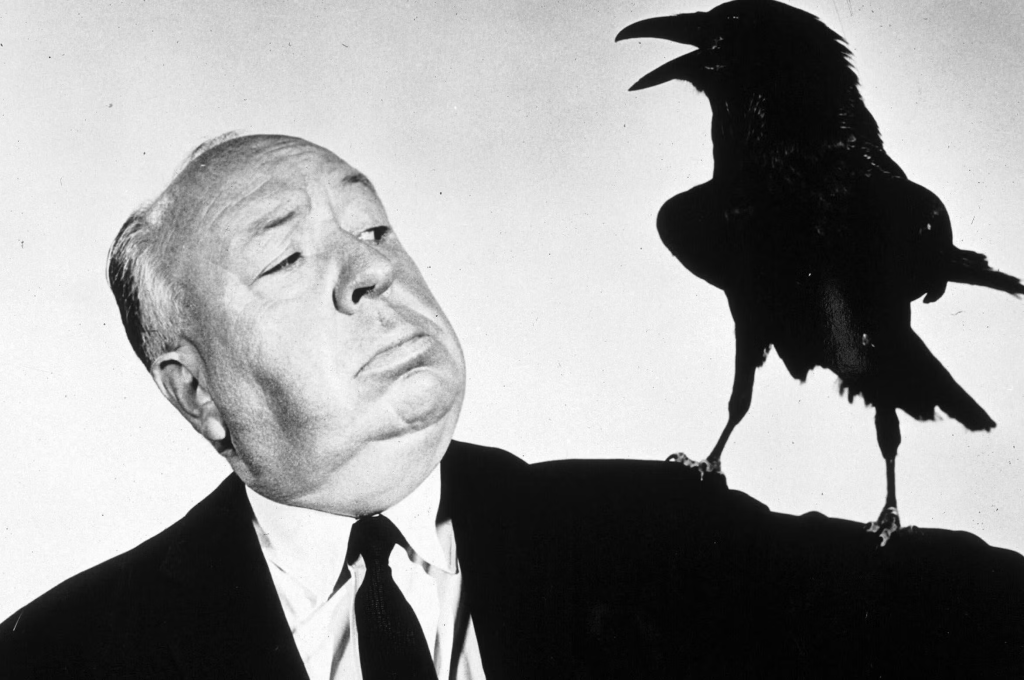
As a shameless ‘film bro’ and an avid horror fan, I felt like it was my duty to experience the work of a man who is often regarded as one of the greatest filmmakers in history. I’m referring to, of course, the ‘master of suspense’ Alfred Hitchcock. I got hold of a boxset of four of his most highly regarded films; Rear Window (1954), Vertigo (1958), Psycho (1960), and The Birds (1963). I watched them over the course of a week with my dad in release order, and, since it was Hitchcock, I thought I would do what I do best with movies – get all my thoughts out on this blog. What did I think? Did I enjoy them? Do they still hold up 60+ years later? Do I finally understand why Hitchcock is regarded as one of the greatest filmmakers and as the ‘master of suspense’? Read on and I will leave you in suspense no more…
First up was Hitchcock’s 1954 murder mystery Rear Window. It follows photographer L.B. ‘Jeff’ Jeffries (James Stewart) as he is confined to his apartment by a broken leg, with nothing better to do than spy on the neighbours across his Greenwich village courtyard. His spying takes a turn when he begins to suspect one of the neighbours has murdered his wife, and so Jeff enlists the help of his girlfriend Lisa (Grace Kelly) and nurse Stella (Thelma Ritter) to solve the mystery. What impressed me about this film was that the story unfolded almost entirely through Jeff’s apartment window through the perspective of his binoculars. What made this even more impressive was the detail that was put into constructing the elaborate set for the courtyard. It took six weeks to build, complete with lighting to accommodate both day and night sequences, and even included a drainage system for one rain sequence in the film. It was apparently the largest set built at Paramount studios at the time. It has a slow start, as the film is set in the same apartment, with the same shots, centred around the same three characters, yet it somehow still immerses the viewer in the narrative. The film confines you to Jeff’s wheelchair as he attempts to solve the murder mystery which makes it all the more gripping, and the last 20 minutes especially tense. There are certain shots in this film that are haunting and will remain with me for a long time.
Next was Vertigo, which if made today, would almost certainly be directed by Christopher Nolan. It is arguably Hitchcock’s most technically ambitious film, as it uses some unconventional special effects and is the first film to use the dolly zoom (when a camera zooms into a subject whilst physically moving away, distorting the background). The film follows former detective John ‘Scottie’ Ferguson (James Stewart once again) who has been hired as a personal investigator by Gavin Elster (Tom Helmore) to follow Elster’s wife Madeleine (Kim Novak). The elaborate plot of the film hinges on Scottie’s extreme fear of heights that stemmed from a traumatic experience earlier in his career. Despite the name, it doesn’t portray the condition of vertigo, but the dolly zoom is used to good effect to represent Scottie’s fear of heights. The plot is interestingly constructed, and the way Scottie’s fear is portrayed and weaved in throughout is very Nolan-esque. There’s some exceptional camera work which sells Scottie’s condition, and there’s one particular dream sequence which is the pinnacle of 1950s movie effects, and appears rather out of pocket compared to the rest of the film. My main issue with this film is that it is the archetype slow burner. Granted, it’s of the time, but the pace remains the same up until the last 20 minutes. At which point there is a significant plot twist which somewhat pays off the rest of the film, but generally the pacing is something you’ll have to bear with to appreciate the film fully. Still, there’s some tense moments and I can understand why it receives the praise it does. I always find it hilarious how terribly awkward love making scenes are in old movies. The actors look as if they have been given strict direction to underplay the passion.
Next was not only Hitchcock’s most iconic film, but one of the most iconic films of all time. What can I say about 1960’s Psycho that hasn’t already been said? It stars Vera Miles as Marion Crane who ends up at the notorious Bates Motel, where manager Norman Bates (Anthony Perkins) seemingly cares for his housebound mother. What follows reset the genre for horror, suspense, and even gore. This was the slasher before slashers, simply because it’s more suspense than actual slashing. I have no doubt the gore in this film back then was the equivalent to Saw now. The difference is, the violence in this film hits harder not because of the violence itself, but the care that Hitchcock put into creating a suspenseful build up. The reason this film is so timeless is because of how simple yet effective horror filmmaking is. Something as simple as a slow camera pan or a musical cue can create gripping tension when well executed. Bernard Herrmann’s iconic score is perfectly chilling, and provided the cookie cutter for horror movie and suspenseful scores to come. Anthony Perkins was exceptional as Norman Bates, from his awkward mannerisms and stutter to that psychotic stare at the end. His performance is like something you’d see in a film today, which is exactly why it still holds up. Granted, this film has its slow and duller moments and some of the dialogue is rather stilted but it’s not enough to break up the experience. This film also has one of the most memorable and chilling ends to a film I’ve ever seen…that smile.
Finally came 1963’s The Birds. Having only just watched Psycho a few days prior, I couldn’t help but think it was more than a coincidence that Norman Bates had a fascination with taxidermy birds prior to Hitchcock making a film called ‘The Birds’. The Birds stars Tippi Hedren as socialite Melanie Daniels who meets lawyer Mitch Brenner (Rod Taylor). Tippi is apparently so infatuated by Mitch that she follows him to his hometown of Bodega Bay with some lovebirds in tow. What follows is an avian onslaught; hundreds of birds begin attacking the people of the sleepy coastal town. Apparently, Hitchcock told the writer to develop the characters and a more elaborate story whilst keeping the concept of the original short story it is based on. It really shows. The first half of this film is about an unconvincing romance which makes Melanie’s actions the first 10 minutes rather toe-curling. Meanwhile the ominous presence of the birds is drip fed throughout, until about halfway through when the real bird attacks go up a gear. The concept of birds being a threat to humans is an interesting one. Birds are everywhere and there’s nothing we could do to stop them relentlessly attacking us in droves. It’s classic Hitchcock to turn these creatures which we live alongside and take for granted into a demonic and malevolent presence, all without a musical score too. Given the time of release, I imagine the special effects were also exceptionally impressive. I understand the characters are meant to be self-indulgent in their own ways to justify them being attacked by birds, but most of the dialogue I found quite unconvincing and one-dimensional. The film suggested the lovebirds were a plot device which would connect to the bird attacks, but surprisingly no such connection was outright made. Perhaps this was left intentionally ambiguous and merely implied by Hitchcock, but as such, I wasn’t entirely sure whether to take this film seriously. Nonetheless, from a technological and horror standpoint I can see why this film broke new ground and I can appreciate it for that.
I would describe watching some of Hitchcock’s highlights as enjoyable, but also educational. It was interesting to see from where much of the horror and suspense of today’s cinema is derived, and to watch some of the staples of classic cinema from a transitional time between old and new Hollywood in the 1950s-60s. My dad and I also watched the 2014 biopic Hitchcock, which tells the story of Hitchcock’s relationship with his wife Alma Reville whilst filming Psycho. The film was enjoyable, mainly due to the performances of Anthony Hopkins and Helen Mirren. However, as the film covered a a long period of Hitchcock’s career, it only really focuses on the key events. It felt rather like a service film for Hitchcock fans, which detracted from the depth it could have had, especially during the making of Psycho itself. Nonetheless, the portrayal of Hitchcock’s awkward relationship with his wife is fascinating, as are the general nods to Psycho. Hitchcock’s films are the reason cinema is timeless. As I’ve mentioned in previous reviews of historical films, it’s always rewarding to see how great writing, acting, and filmmaking holds up after over six decades. This provided further evidence that time is irrelevant to film quality. To me, watching films from over six decades ago isn’t just a source of escapism into the stories themselves; it is also intriguing how they reflect the times at which they were made. It’s inspirational to see how far cinema has come, and the impression that that ambitious Englishman from East London made on movies.
Vampires have always been one of the most intriguing aspects of supernatural fiction. Ever since Bram Stoker’s 1897 novel Dracula, vampires have been one of the foremost aspects of the horror genre. With the rise of superhero comics in the 1960s and 70s, it wasn’t long before the wizards at Marvel created a character which crossed the superhero and vampiric genres together. Enter Morbius: The Living Vampire, who made his first appearance as a Spider-man villain in 1971’s The Amazing Spider-Man #101. The idea of a scientist turning himself into a monster in an attempt to better himself isn’t unfamiliar in fiction, but the character of Michael Morbius places an interesting twist on this. To have Dr Michael Morbius turn himself into a vampiric superhuman attempting to cure a rare blood disease creates an ironic twist which blends the superhero genre with the supernatural. The new Morbius film directed by Daniel Espinosa retells the story of this tragic anti-hero, and whilst it may be not be perfect, it is a unique addition to the plethora of comic book films.
Morbius follows Dr Michael Morbius (Jared Leto), a Nobel prize-winning scientist with a seemingly incurable blood disease which is slowly killing him. In a ditch effort to find a cure, he experiments with bat DNA which leads him to turn himself into a vampiric monster who cannot function without consuming blood. What I enjoyed most about the film was it’s dark, supernatural flavour, which sets it apart from any other Marvel film. In a world where we have a Marvel Cinematic Universe made up of big-budget, family friendly flicks, it was nice to see Marvel do something a little different. From what I’ve read of the original comics, it seems the film was relatively close to the source material in terms of the character’s origins. Michael’s first transformation happens on a ship, as in the comics. He becomes the monster and hunts a group pf unsuspecting mercenaries in what is almost a tense, horror-esque action sequence. Whilst the slow-mo moments in the action sequences were rather slick, the action was generally very shaky and too fast paced to the point where you can’t tell what’s going on. In fact, this almost made me think they only added slow-mo moments so you could tell what was going on!
In terms of its story, Morbius has both pros and cons. In the film, he is a sympathetic figure; you understand why he goes to the lengths to save himself, and you can tell he is a genuinely good man trying to do right by himself and others. He doesn’t want this vampiric curse because of the harm it could cause others, yet he struggles to fight the need to consume human blood. This is exactly what Morbius is about; the classic battle between morality and animalistic nature. That said, it would’ve been good to see more of this conflict between man and beast. As I said, the film makes it clear Michael is a good man, but not much else. We don’t see him kill anyone he wasn’t supposed to, or cause any harm to any loved ones. In fact, he seems to gain control over his condition relatively quickly. In the comics, he is constantly battling the urge to consume human blood, even from those he cares about. Whenever he does, he is in anguish at his actions, condemning himself as a dirty, corrupt soul. Unfortunately we don’t see much of this in the film, as the story focuses more on his conflict with his surrogate brother Milo (Matt Smith). It almost seems that they translated the man/beast conflict between Morbius and Milo, rather than have it be within Morbius himself. Milo is afflicted with the same blood disease as Michael, and when Milo uses the same treatment as Michael, he embraces his lust for blood and new-found superpowers after a life of disability. Matt Smith’s performance as Milo was possibly the most enjoyable aspect of the film, giving a convincingly sympathetic performance as the villain who, unlike Morbius, embraces his vampiric side. Other supporting characters include Michael’s girlfriend Martine, portrayed by Adria Arjona, who provides Michael with the ‘moral compass’ throughout the film, and Jared Harris Dr. Emil Nicholas, Michael and Milo’s father figure. Martine and Dr. Emil aren’t the most memorable of side characters, but they provide us with external observers of Michael and Milo’s predicament, and remind us of the moral ambiguity of their actions.
Morbius is far from a perfect film. The action sequences are choppy, the characters aren’t quite developed as they should be, and the post credit scenes feel like Sony attempting to grasp at straws to connect Morbius with the wider Marvel universe. However, as a stand-alone Marvel film about a character with a sympathetic predicament and supernatural abilities, there is still some enjoyment to be had. This is quite possibly the first Marvel film to verge on the supernatural since the Blade trilogy of the late 90s and early 2000s. This is what sets it apart from other Marvel films. It’s dark, gritty atmosphere and unique supernatural twist on the superhero genre provides a refreshing change to the typical superhero formula we are all too familiar with. The character has had a rough ride through comic history, going through many changes of writers and some periods where it seemed the character was left to lie dormant. As such, it was nice to see such an intriguing character have a shot at a live action feature film, even if it wasn’t quite what fans had hoped for. Hopefully, Sony will listen more to the wishes of fans in future, and give us more of the character’s anti-heroic nature which made him so iconic in the comics.
It’s the early 1960s. The Marvel comics industry has already produced a colourful variety of iconic characters such as Hulk, Thor, Iron Man and Spider-Man, still within the first few years of their creation. Then one day, comic legends Stan Lee, Bill Everett and Jack Kirby decide – “Hey, what if we created a disabled superhero?”. This superhero’s disability would be that he is blind, but his big compensation for this is the fact that his four other senses are heightened to super-human level. Not only that, but his every day alter-ego is a lawyer named Matthew Murdock who fights crime using the legal system. This is juxtaposed to the fact he is a vigilante at night who catches criminals who slip their way through the legal system; because sometimes the law just isn’t enough. This is a man who pushes away his loved ones as he attempts to balance these two lifestyles, a man whose religious faith is ironically reflected by the fact he beats up criminals dressed as the devil. A man with the heroism of Spider-man and the emotional complexity and darkness of Batman. A man who attempts to lift Hell’s Kitchen from its criminal damnation by working both sides of the law. A man who faces loss, abandonment, trauma, and constantly struggles with his identity whilst still defending his city. A man, without fear.
To me, all these things are what make ‘Daredevil‘ one of the most unique and intriguing characters in the Marvel universe. The character resonates with me in a way that not many other characters do. The very concept of a blind superhero was enough to interest me, but his abilities and emotional complexity is what put him on my personal pedestal. Matthew Murdock lost his sight at a very young age when a radioactive substance splashed into his eyes, whilst attempting to save an old man from the truck carrying said substance. Initially, you’d think being blinded is quite possibly one of the most nightmarish experiences a person could go through, considering how much humans rely on their sight. But Matt made it his mission to transform his disability into a strength. A strength that he could later use to commit more acts of heroism like the one that cost him his sight. Not only did he lose his sight, but Matt also lost his boxer father, Jack ‘the devil’ Murdock, who refused to intentionally lose a fight for a mobster. Jack used to encourage Matt to not become a fighter like him, but instead study to become a lawyer or doctor to make the world a better place. Like so many other superheroes have shown, loss is a powerful motivator, and Matt was then motivated to support his father’s wish, but also to bring the criminals who murdered his father to justice. This led to the dual lifestyle that Matt leads as lawyer-by-day and vigilante-by-night. This bipartite personality reflects the different ways of how we choose what the ‘right’ thing to do is. We like to keep our loved ones close as they inspire us to be our best selves, using our knowledge and rationality to defend others and resolve injustices. This is the Matt Murdock in all of us. On the other hand, it is only human to give into our emotional impulses, and resolve injustices by whatever means necessary, even if it sometimes means pushing away our loved ones. In other words, sometimes we simply need to ‘let the devil out‘. This is the Daredevil in all of us.
The world of Daredevil and Matt Murdock is perfectly encapsulated in Netflix’s Daredevil series. This is the series which first absorbed me into the character and his world. The series opens with its protagonist sitting in a confession box admitting he needs to ‘let the devil out’, setting up for something which will blur the line between right and wrong. What separates this series from other Marvel TV shows and movies is its perceptiveness and grit. It isn’t afraid to explore deeper themes and make flawed characters likeable. Its reliance on dark, grainy cinematography to encapsulate a much darker comic book story rather than overusing CGI makes it much more grounded and real than most other Marvel properties. Season 1 isn’t just a superhero show – it’s a 13-episode character drama about how far protagonists and antagonists are willing to push the moral boundaries to do what they believe is ‘right’. Charlie Cox’s performance as Matt Murdock is possibly my favourite portrayal of a comic book character; he is to Daredevil what Robert Downey Jr was to Iron Man. He brings likability and emotional complexity to a flawed character, similarly to the antagonist of the series, Wilson Fisk, portrayed by Vincent D’Onofrio. Fisk does unspeakable things throughout the series, but still manages to provoke feelings of empathy and understanding with the audience. He is intimidating, anxious, calculating, and somehow empathetic all in one. He doesn’t need superpowers or weapons to show his power. Simply by displaying the effect he has on people and what he makes them do for him before he even appears on screen is enough to show how much of an unstoppable force he is, and how he truly lives up to his comic book alias, ‘The Kingpin’.
Whilst some argue season 2 of the series wavers in its objective quality, upon several re-watches I have come to appreciate the thought and depth placed into its story arcs. The first few episodes centre around one of Marvel’s most compelling and morally ambiguous villains – the Punisher. Once again, Jon Bernthal to me is the Punisher like Robert Downey Jr is Iron Man. He is a man to be feared by criminal organisations yet the series isn’t afraid to show his more emotional, familial side. Should we simply kill criminals so they don’t commit their unspeakable crimes again? Or does every criminal, no matter how terrible their crimes, deserve a chance at redemption? This intriguing dilemma is discussed in depth between Daredevil and Punisher, showing two different perspectives on the idea of vigilantism yet showing how similar these two characters are. As the Punisher says to Daredevil – ‘You’re one bad day away from being me.’ That is what makes these characters some of the most compelling in the Marvel universe. The parallels drawn between them throughout the series show how easy it would be for Daredevil to kill and turn into those he fights so hard to defend Hell’s Kitchen from. Season 2 also crafts a story about what it means to live two different lives, as Matt struggles to maintain his day life as an attorney with his night life as the man without fear. He pushes his two closest friends away, Foggy Nelson and Karen Page, trying to balance the demands of the Punisher’s trial as Matt Murdock and the fight as Daredevil with a secret organisation known as The Hand. He forms romantic connections with Karen as Matt Murdock, and with assassin Elektra as Daredevil, epitomising the struggle of which life is best to lead. The more absorbed he becomes in one, the more it infects the other. Season 2 creates believable conflict between those who call each other friends, and understanding between those who call each other enemies. It encapsulates the dichotomy of right and wrong, and how many different approaches there are to achieve what an individual believes is the ‘right’ thing to do to protect others.
My cosplay of Daredevil’s first vigilante outfit from season 1 of the Netflix show
As if the first two seasons weren’t enough to fulfil even the Devil’s appetite, Netflix and Marvel provided us with a third (and possibly final) season of Daredevil. Season 3 effectively uses what made season 1 great and adds refreshing new dynamics to Matt’s defence of Hell’s Kitchen. A broken, beaten Matt seemingly has abandoned his everyday life as an attorney and fully embraced his vigilante persona. Not only this, but the Kingpin of Crime, Wilson Fisk, has returned to the Kitchen and proves that house arrest is far from enough to keep his atrocious criminal schemes at bay. Season 3 also provides us with an intriguing portrayal of one of Marvel’s most underrated villains, Bullseye. Season 3 turns what was originally another costumed assassin who can turn any object into a deadly projectile into a compelling yet terrifying antagonist for Matt Murdock. Bullseye, or known in the series as Poindexter (Wilson Bethel) is an unhinged FBI agent whose childhood abandonment and unresolved psychopathy leads him to become a tool of Fisk’s to incriminate Daredevil with the very crimes Fisk is guilty of. Not only does this parallel Matt’s own abandonment issues from his mother, but it provides us with yet another antagonist who has understandable motives yet atrociously goes about fulfilling them. Similarly to D’Onofrio’s Fisk, he is a villain whose actions you do not condone, yet with a character skilfully crafted to provide an understanding of why he is like he is. The impending clash between Daredevil, Fisk, and Bullseye occurs in one of the most climactic series finales I’ve ever seen. Will Bullseye kill Fisk’s wife Vanessa before Daredevil can save her? Will Daredevil cross the line and kill Fisk? Charlie Cox provides an award-worthy performance as he cries out in pain when the opportunity to kill his adversary arises but he can’t bring himself to do it. What makes the protagonist of Netflix’s series a hero is not Daredevil, but Matt Murdock. As Fisk urges Matt to kill him, Matt exclaims “You don’t get to destroy who I am“. If Matt kills Fisk, Fisk wins. Daredevil becomes a hero by maintaining the integrity of his humanity, by choosing not what is easy, but what is right. I could probably write pages and pages more about why Netflix’s Daredevil is one of the best series of the 2010s. About the stunning comic-book inspired cinematography, the intense, dark soundtrack by John Paesano, and the performance of every actor. But it’s a series you should simply watch for yourself, because I believe it is a series that every comic book fan should experience and could learn from.
Netflix’s masterful series inspired me to indulge in other Daredevil media and explore the world of Matt Murdock further. Comic book writers and artists have provided us with some of the most stunningly drawn and compelling tales in the Marvel universe. Kevin Smith’s Guardian Devil storyline not only provided the basis for the 2003 feature film, but also became one of my favourite comic book stories to date. An infant is mysteriously placed into the care of Matt Murdock, which is revealed to be either the Messiah or the Antichrist, leaving Matt to struggle with his faith in Catholicism and how it weighs on his sense of morality. The story isn’t afraid to deal with themes like substance abuse, suicide, and religious faith. I couldn’t talk about Daredevil comics without mentioning the main man who made the character what he is today, Frank Miller. Miller took Lee and Everett’s creation and placed him into much more real-world scenarios, and immersed him in darker themes and conflicts which readers could resonate and empathise with. Miller’s Born Again story arc is regarded as one of the greatest and most influential Daredevil storylines. Having discovered Daredevil’s secret identity, the Kingpin is hell-bent on bringing down Matt Murdock in every way he can, leaving Matt to pick himself up and find the willpower to pursue his adversary. With its uniquely religious symbolism and struggles with identity, Born Again provided much of the inspiration for seasons 2 and 3 of the Netflix series. Even the criticised 2003 feature film starring Ben Affleck I find enjoyment from. It may have some toe-curling cheesiness, but I appreciated its performances, tone, faithfulness to the comics, and of course those underground-early 2000s Matrix vibes which most comic book films tended to have back then.
Whatever media is used to portray the story of Matt Murdock, whether it be film, TV, or graphic novel, I have come to appreciate him as one of the most interesting and unique characters in the Marvel universe. The way he turns his disability into effectively his greatest assets is awe-inspiring, and shows that irrespective of potential disadvantages, you can still stand up for what you care about. I recently read Travis Langley’s book, ‘Daredevil Psychology: The Devil You Know‘ which explored the complexity of the character and his powers using psychological literature. As Langley writes in his final essay of the book, “Life’s balancing act lasts as long as we do“, which I believe encompasses what makes Daredevil so compelling. The character epitomises the dichotomy of life and morality; lawyer by day, vigilante by night; working both inside and outside the system. Do we indulge in our emotions or keep ourselves level-headed? It shows how things aren’t always as simple as right or wrong or good versus evil. Daredevil taught me things about myself which I wouldn’t have even considered before, and provided me with a reason to express my passion and resonation with the world of comic books and TV. But most importantly, the character taught me to always have faith, no matter the odds. It’s fair to say Daredevil is my favourite comic book character of all time.
Another cosplay of me as Matt Murdock himself, in a world where he decided to grow out his hair (Photos by Jacob McCormack)
On 5th October 1962, Dr. No was released in cinemas and kick started a global phenomenon and an integral part of British pop culture. 59 years later, on 5th October 2021, yours truly went to the cinema to watch the 25th James Bond film; No time to Die. Obviously you’d have to be very lucky to meet someone who has seen every single Bond film in the cinema, that would be incredible! However, thanks to the fantastic modern technology which is Blu-ray, over the past year I have watched through 24 Bond films with my dad at home. Now having watched the 25th and Daniel Craig’s final instalment as 007, and I can say that these films really stand as a testament to how much cinema and British culture has changed over the past 60 years.
The main similarity I found all the Bond films to have, whether it was George Lazenby or Daniel Craig, was that they all had the same ‘essence’. No other spy or action movies could capture the same essence as the Bond films. It’s almost like the Bond films have a secret recipe. The same ingredients, just different flavours. Sean Connery is the classic Victoria sponge cake, whilst Daniel Craig is the more zesty red velvet cake. The ingredients include a far-away, exotic country, the swimsuit love interest, 007’s banter with Q, the gadget cars, the cheesy one-liners, and of course a scarred villain with an atrocious plan for the world. These ingredients are things we’ve come to expect from every Bond film, but they’re not the sort of clichés we get tired of after two or three runs. These sort of clichés we appreciate as part of the Bond recipe just as we still appreciate a Victoria or red velvet cake the 25th time we’ve eaten one.
I’m quite optimistic when it comes to films. Even if a film receives mixed reception by fans and critics, I can still appreciate it for what it is; film makers bringing their creation to life and doing something they love. The Bond films are no exception. Even if the films do tremble in their objective quality, and even if some scenes aren’t portrayed as convincingly as they should be (not naming any names on behalf of Her Majesty’s Secret Service), I still found enjoyment out of every single one of them. All misogyny aside, Sean Connery was James Bond. He was the template for all the other to succeed him, and had the perfect balance between serious moments and cheesy one-liners. Every time he was on screen I felt like he was going to charm the hell out of me. Now say what you will about George Lazenby, but I loved the snowy, mountainous setting in Switzerland in Her Majesty’s Secret Service. From the facility with Blofeld’s Angels of Death to the bobsleigh chase, the Switzerland setting was definitely a stand-out for me. By the time Roger Moore came around, the Bond recipe had become relatively iconic and unique, especially to me as it was my first time watching through them. Moore’s campiness of 007 is what made him stand out to me. I don’t think I could see Sean Connery or Timothy Dalton unzipping a woman’s dress with a magnetic watch followed by the line “Sheer magnetism darling”. None other than Roger Moore would have wrestled with a python and simply said “I discovered he had a crush on me”. I found myself laughing most throughout Moore’s run, but not in a bad way; simply amused by his boldness to make such cheesy one-liners in serious situations.
I found Timothy Dalton to be the most emotionally-charged, lovey-dovey Bond. Probably the least misogynistic Bond to date, Dalton nailed the seriousness of the character and had some of what I found to be the more believable love interests. Pierce Brosnan however balanced Moore’s campiness and Dalton’s seriousness, and was what I believed to be the most ruthless Bond to date. He had the guts to intentionally drop Sean Bean onto solid concrete and gun down what would’ve been a potential love interest. Brosnan was absolutely merciless and did what needed to be done, which I loved. Last, but most definitely not least, was Britain’s current national treasure, Daniel Craig. To me, Craig was the perfect encapsulation of a 21st-century Bond. Connery set the template and Craig made it his own. He had the charm of Connery, the one-liners of Moore, the emotion of Dalton and the ruthlessness of Brosnan. Not to mention he stars in my personal favourite, Skyfall. And No time to Die is a brilliant send off to him and a fulfilling ending to Craig’s run as 007. Watching the clip of Craig on the set of No time to Die expressing his love and enjoyment for making these films was awe-inspiring. Whether it be chasing Blofeld down a bobsleigh track, or hunting down a disfigured Freddie Mercury, the passion of the film makers will always be felt in the essence of the Bond films.
As much as I’ve enjoyed the journey through the history of 007, this isn’t to say I’d personally welcome some change-ups to the recipe. I’d love to see new cast member Lashana Lynch take up the role, or even the likes of Idris Elba (although please keep Ben Whishaw as Q for a few more at least, I beg). Furthermore, I’d fully support a villain that doesn’t have some facial disfigurement. But ultimately, it really doesn’t matter what the characters look like, the Bond recipe has stood the test of time and I have faith it will stand for another 25 movies.
Every Wednesday Disney’s streaming service, ‘Disney+’ surprises me with new shows and movies I wouldn’t have expected to be on there. I guess I can count Disney’s acquisition of Fox a blessing because Wednesday 15th September 2021 was no exception. Within a week I had watched both seasons of Orville and I’d cried a total of three times watching it.
On that Wednesday I had a friend round and we were on Disney+ having just watched the latest episode of Marvel Studio’s ‘What if?’ (an absolute brilliant anthology series which places unusual twists on the Marvel Cinematic Universe). We happened to notice a new series had arrived on Disney+ – a sci-fi Star Trek parody created by the man behind Family Guy and Ted, Seth Macfarlane. Say what you will about Seth, but Family Guy never fails to make me laugh, and movies like Ted and A Millions Ways to Die in the West are brilliant live action translations of his humour. Probably what I love most about the man is his clear passion for pop culture references (especially 80s movies). Orville is not only an all-encompassing sci-fi reference in itself, but a love letter to Star Trek and anything else sci-fi.
*Minor spoilers ahead for The Orville*
Initially I thought The Orville was going to be a comedy sci-fi, but after just the first few episodes I was pleasantly mistaken. Orville is a sci-fi with comedy, but it is not the main aspect of the show. The main aspect of the show I love and the reason everyone should be watching is the characters. You’ve got Ed Mercer, captain of the flagship (literally) of the show, the Orville, who is still dealing with feelings about his second-in-command ex-wife Kelly Grayson (Adrianne Pallicki). Mercer is proof that Seth Macfarlane is as skilled with a serious role than he is with comedic roles. Mercer sets the example of what a good leader should be. He is placed into the most unique moral dilemmas and makes the tough calls that no one else can. Would you destroy a ship of racist aliens if it meant saving thousands of lives even if there were children on the ship?
Not only that, Mercer maintains a brilliant rapport with his subordinates. This includes Lt. Gordon Malloy (Scott Grimes); Malloy is what I can best describe as the Orville’s ‘crew clown’ with a heart of gold. Lt. Commander Bortus (Peter Macon), an alien from the planet Moclus, a planet which dictates every female child must undergo gender transformation surgery to maintain the male-dominated population. Bortus often finds himself stuck between the backward politics of his planet and his sense of duty and morality established by the relationships with his fellow crew. Another alien species, Lt. Alara Kitan (Halston Sage) from the planet Xelaya whose high levels of gravity grant her super-strength aboard the Orville. Then there is Isaac (Mark Jackson), a robot from a planet dominated entirely by artificial lifeforms who forms a relationship with the Orville’s chief medical officer Claire Finn (Penny Johnson Jerald). Isaac is completely emotionless but is always keen learn more about biological lifeforms, so when Claire develops feelings for him after he unintentionally assumes the role of father figure to her two children, the debate as to whether a human can date an A.I. becomes very apparent amongst the crew. Lastly there is Lt. John LaMarr (J. Lee) who unlocks his true potential and becomes chief engineer after the crew discovers his hidden intelligence.
The relationships between these characters and the way they deal with all sorts of unique moral dilemmas is why The Orville is such a brilliant show. Every episode pleasantly surprised me with some unique scenario these characters are placed in. For example, would you date an ex you still had feelings for which came back into your life from the past? Would you still want to be with the love of your life even if she only existed inside a simulation? Would you be brave enough to run away from a society based on sexism even if it was all you had? These sort of questions are the reason I ended up watching both seasons within a week. Many of the episode plot lines are almost Black Mirror-esque in the way they deal with the dangers and possessiveness of technology. In 400 years will many of us be working aboard a government space ship falling in love with robots and computers? The relationships between the characters are the reason the show had me welling up a total of three times within a week of first watching it! The Orville gave me feelings I was not expecting to have from a Seth Macfarlane show I picked up purely by chance. I have a new found respect for Seth and his skill set as a writer/director, and I find it astounding The Orville has not received more recognition. If you enjoy sci-fi in the slightest, or if you enjoy a show with plenty of heart with relatable characters, unique dilemmas, and stella production value then you need to watch The Orville.



 G does Films