Asa Butterfield’s poignant stage debut as…Harry Potter? A Review of his stage debut in ‘Second Best’

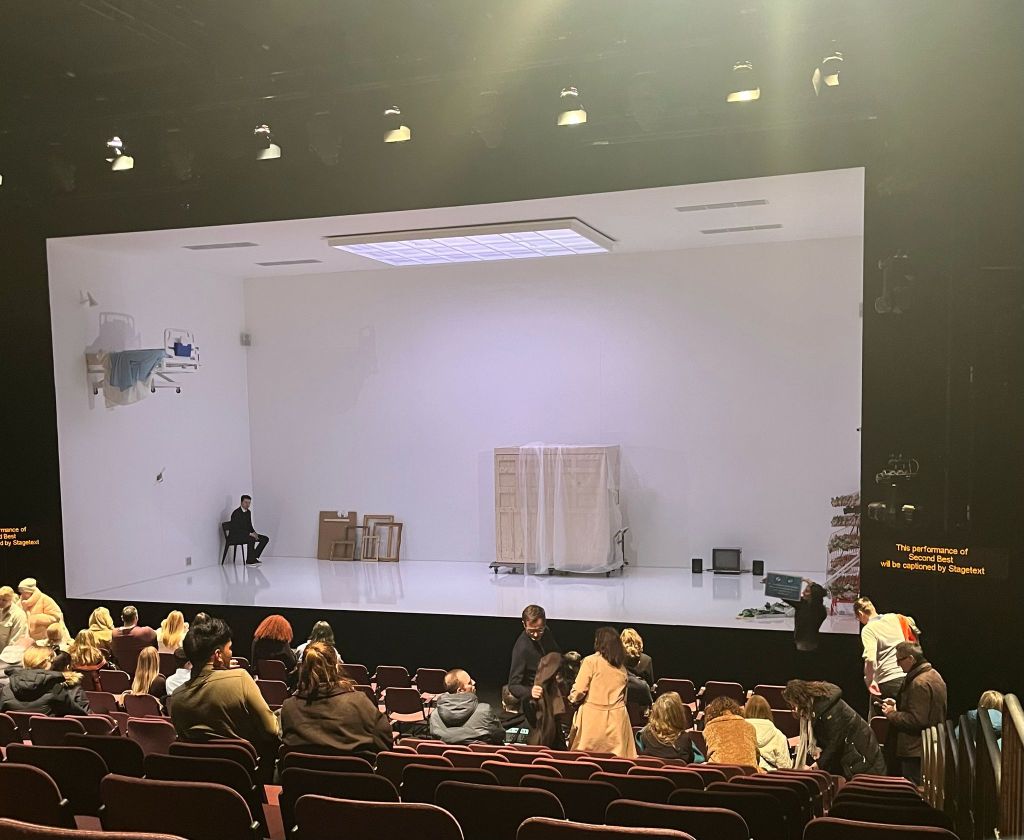
Asa Butterfield is on his own. He sits on a chair on the stage of Studio 2 at Riverside Studios in London. He occasionally gets up to wander around and pass reflective glances at the audience shuffling into their seats. What follows is a story about missed opportunities, fate and family, told solely by Butterfield and strangely revolving around Harry Potter…

Second Best is the fictitious story of Martin Hill, a man, who at 10 years old, was one of the two final contenders to play Harry Potter. Based on a novel of the same name written by David Foenkinos, the one-man play is effectively an uninterrupted monologue of Martin Hill telling the story of his life and the knock-on effect missing out on the role of a lifetime had. Definitely one of the most unique plays I’ve ever seen, not only does it begin with Butterfield already on stage, he continues to be present for the entire duration of the play. Arguably one of the most famous British child actors of this generation, popping up in series’ such as BBC’s Merlin (2008) and Ashes to Ashes (2008), and films like The Wolfman (2010), and Nanny McPhee Returns (2010). Until he received wider recognition for The Boy in the Striped Pyjamas (2008) and Martin Scorsese’s endeavour into the family genre in Hugo (2011). Of course, most young adults will most likely know Butterfield as Otis Milburn from Netflix’s Sex Education.

Arguably dissimilar to his screen work, Second Best allows Butterfield to express his full acting range, from the humorously endearing awkwardness of Otis Milburn to much more poignant, tense emotional moments that the play requires. His exceptional ability to express this range gives the play an undeniable bittersweet feeling. For the most part, it is exceptionally funny, and Butterfield’s comedic timing in the stories he tells land excellently with the audience. However, there are times in the play which deal with loss; not only losing the role of a lifetime, but the loss of family and of one’s sense of self. Butterfield portrays such moments with unexpected sensitivity, evoking great sympathy for Martin Hill and reminds us how easy yet dangerous it is to reflect on what could’ve been.

The stage itself is also very uniquely designed and arranged to reflect the play’s bittersweetness. It is a white room with various seemingly random objects scattered around. From corner shop crisp shelves to a hospital bed affixed high up on the wall, these objects are the only other actors on stage with Butterfield. They act as visual accompaniments to Butterfield’s storytelling, giving the play a personal touch of the things we associate with certain memories and feelings. Moreover, there is a wardrobe from which Butterfield retrieves certain costumes and props, with some hilarious nods to Harry Potter itself. Second Best pokes fun at Harry Potter; the inescapable scale of a global phenomenon and the use of certain terms and phrases to create some admirable irony.

Solely the fact that Butterfield’s stage debut was a one-man play is impressive, but the range he provides in his performance makes it even more so. It was truly wonderful to see a British actor who popped up so frequently in my adolescence and whose roles had some personal resonance with perform on stage. I do hope the reception Second Best has received encourages Butterfield to pursue further theatre endeavours, as he has clearly made the transition from screen to stage with exceptional grace. Second Best was one of the most uniquely funny yet poignant plays I’ve seen, and it is a play I would recommend to anyone who enjoys something different on stage, is an Asa Butterfield fan, or simply even a Harry Potter fan.
Waiting for Godot at the Theatre Royal Haymarket – A Review

What are you waiting for?

We’re waiting…for Godot.

Life hinges on asking questions. If we didn’t ask questions, we wouldn’t get anywhere in life. Playwright Samuel Beckett sussed this out when he wrote his surreal play, Waiting for Godot, in the 1940s. The play reflected the hopelessness and uncertainty in a post-WWII world, whilst the satirical banter between its characters giving it a strangely playful side. It was first performed in a tiny Parisian theatre in 1953 and was received very divisively. Understandably so, as the play asks many questions, and potentially leaves the audience asking even more. Today, however, Waiting for Godot is one of the most famous plays ever written, and has been widely regarded as a classic. I recently found out why.

At London’s Theatre Royal Haymarket, there is a stage upon a stage. The actors stand upon a section of barren countryside. There is nothing except Ben Whishaw’s Vladimir looking skyward next to a scraggy tree, and Lucian Msamati’s Estragon sitting on a rock missing a boot. What follows is an exceptionally thoughtful journey into both hopefulness yet hopelessness, and absurdity yet solemnity. The play centres on these two characters who have nothing waiting for a mysterious figure to arrive and give them something. Who is this character? What are they going to do? How do these two men know him? These are all questions left relatively unanswered, and instead the play explores the meaning of life, accepting the absurd, and why we might wait for something that may never come.

Admittedly, I knew very little about this play beforehand. In fact, I wasn’t familiar with any of Samuel Beckett’s work beforehand. Interestingly, I would’ve described the plot of the play the exact same way before watching it as I would after. It isn’t, effectively, about anything in particular. The enjoyment comes from watching the performances and absorbing the conversations. What initially attracted me was Ben Whishaw and Lucian Msamati. Their chemistry and comedic timing carries the majority of the 2 hour and 45 minute runtime. Whishaw’s youthful look and intentionally child-like Vladimir contrasts perfectly to Msamati’s more begrudged, clueless Estragon. If anything, Waiting for Godot proves the two actors are certainly amongst the British greats. Msamati was especially magnetic with his comedic timing and delivery. One such moment occurred when he approached the front of the platform, overhanging the front of the stage, just as some latecomers entered the stalls. Before delivering his line, he stared at them and disappointedly shook his head, gave his line, and there was an instantaneous applause.

Another such moment of audience elation came during a moment with visiting characters Lucky and Pozzo, played by Tom Edden and Jonathan Slinger, respectively. The two pass by Vladimir and Estragon several times in the play, Pozzo a privileged, foppish individual who leads the non-verbal Lucky around on a rope, seemingly to serve him as a slave. When Lucky is told to ‘think’ amongst other actions, a hilariously lengthy, meandering monologue follows about God, man, Earth, whilst the other characters wander cluelessly around the stage waiting for it to end. Once it is abruptly ended by Vladimir, the audience once again applauded. As such, Edden’s performance was notable for its reliance on physicality, generating some particularly hilarious moments when interacting with the other characters. Slinger as Pozzo was also exceptional, seamlessly slipping between his pompous persona and a more regular one to convey some vulnerability to the character. Whether Lucky and Pozzo are reflections of Vladimir and Estragon is certainly implied, but never blatantly obvious. Both pairs of men rely on each other for survival, and are seemingly two sides of the same coin. Their relationships are never defined, as they threaten to leave each other several times, yet rely on each other for companionship as well as survival.

Initially, I thought that writing about Waiting for Godot would be difficult, but now that I have, I can fully appreciate the play’s timeless themes and iconic characters. Never have I been so entranced by such a minimal play, nor have I ever both laughed and reflected in concurrence. This is mainly thanks to Whishaw and Msamati’s extraordinary performances which will certainly go down as one of the best in the play’s history. Waiting for Godot is a play that reminds me why I love going to the theatre and the craft of acting. It relies on so little yet requires so much, allowing the audience to fully appreciate a cast who are well and truly in their element.

Harry Potter and the Cursed Child is the closest thing to real-life magic

When Deathly Hallows was published in 2007, if you’d have told a nine-year-old Gareth that the next Harry Potter story would be a stage play, I most likely would’ve been flabbergasted. Seeing the magic come to life on the big screen is one thing, but to see it come to life completely on stage is something else entirely. From the simple things like levitating books to the seamless transition between scenes, Harry Potter and the Cursed Child clearly utilises the special effects of a theatre to their highest potential. It is almost like a real-life magic show; many of the feats of magic performed on stage really make you think ‘How did they do that?!’. Some were so fantastical that the audience erupted in applause in the middle of the scene. Whilst the special effects are arguably the core of the production, the play itself provides a heartfelt story with everything we love about the original Harry Potter stories, and more.

Harry Potter and the Cursed Child is a stage play which has been running at the Palace Theatre in London (also at various other theatres around the world) since 2016. It is separated into two parts, which are effectively two separate plays. I remember first hearing the announcement that the eighth Harry Potter story would take place on stage, and that it would be about Harry’s son Albus Potter at Hogwarts. Needless to say I was ecstatic, although it was only until recently that I finally got around to seeing it! After seven books and eight films, what better idea than to have a new Harry Potter story performed live on stage. Without revealing much of the plot, Cursed Child features adult versions of our childhood favourites; including Harry, Ginny, Ron, Hermione and a more-or-less reformed Draco Malfoy. The stars of the show however are Albus Potter and his best friend Scorpius Malfoy (Draco’s son). The play revolves mostly around Albus’s relationship with his father, and how he deals with the legacy of being the son of the famous Harry Potter who stopped the dark Lord Voldemort. In addition, it revolves around Albus’s relationship with Draco; a friendship which provides much of the heart and humour of the play. Luke Sumner, who played Scorpius when I went to see it, was a substantial stand-out; he was so animated and made the character his own, getting many laughs out of the audience. Scorpius is much unlike his father, being rather shy and socially awkward at times, yet clearly with a heart of gold. Thomas Aldridge who played Ron also shined, easily getting the most laughs out of the audience with his whimsical Weasley humour. Even James Howard who played Draco was a highlight, giving us a sympathetic insight into Draco’s character that we’ve never seen before in a Harry Potter story.

I cannot talk about Cursed Child without mentioning the special effects. They push the limits of what is possible on stage, and for that I have the upmost admiration for those who organise it. The fire and light used to represent the spells was bedazzling, one which stood out to me was how they did a certain Patronus spell; wonderfully creative and unique in a way I was pleasantly surprised by. The play also utilises the effects of lighting to create seemingly magical effects, to hide or highlight certain things on stage to cleverly divert the audience’s attention. One scene was even portrayed as being entirely submerged underwater, the actors seemingly swimming around and later appearing in a real pool of water at the front of the stage. The special effects also made the play particularly frightening at times, highlighting the darker elements of the wizarding world with dementors flying around the audience and ominous sound design and lighting to make the audience feel as vulnerable as the characters on stage. The transitions between scenes were done seamlessly so they would never take you out of the play; stage hands dancing around sweeping their magical cloaks to clear the stage and set the scene.

Harry Potter and the Cursed Child opened my eyes to the effort and organisation that must go into creating such a vast stage production. It isn’t like a film where if something goes wrong you can simply restart the take. If something goes wrong on stage you must improvise and make the most of it so as to not take the audience out of the story. Everything from the actor’s lines to the rigging of the effects must be so perfectly timed as to provide an eloquent and bedazzling production which as one of the staff proclaimed as we entered the theatre, will ‘melt your brain’. Stage plays also allow actors to give their performances their all, and Cursed Child is undoubtedly no exception. The cast provide us with newfound appreciation for characters we know, and the ones we’re introduced to. The narrative is well maintained across the two parts, although I enjoyed part 2 more since the stakes and tension were much higher. As someone who doesn’t go to the theatre that often, Cursed Child also opened my eyes to the realms of possibility and enjoyment that theatre plays provide. It made me want to see more stage productions and what they’re capable of. It is a play that not only Potterheads will love, but anyone of any age; it is truly a once in a lifetime real-life magic show.