
Let me just start by saying John Carpenter’s 1978 Halloween is not a perfect movie. Some of the acting is a little choppy and the characters do make some pretty illogical cliché horror movie decisions which don’t do them any favours. Nonetheless, the movie was of its time and it has created some of the underlying staples of horror movies we still see today. Not to mention that the Shape itself, Michael Myers, has become not only one of the greatest horror icons of all time, but one of the greatest movie icons of all time. And what is the horror villain without his scream queen? Laurie Strode (Jamie Lee Curtis) is one of the most iconic scream queens of all time. The movie makes it clear early on that Laurie isn’t a typical damsel in distress who only has sex, drugs and rock and roll on her mind. Laurie is the one who looks out of windows, checks to see if someone is watching her and is genuinely a really good babysitter. By today’s standards, the movie is a plethora of horror movie clichés we are all too familiar with. When you reflect however on the cinema of the time and what John Carpenter did, you may realise that it was in fact 1978’s Halloween which effectively established these clichés. So much so that I believe there is a little bit of Halloween in every horror film.
Before John Carpenter’s Halloween, there wasn’t much in the way of suspenseful cinema about a psychotic killer. The major exception of course being Alfred Hitchcock’s Psycho back in 1960 which combined screechy violins with a crazed killer who made people afraid to step in the shower. Other major horror flicks of the 1970s included the over-the-top slasher Texas Chainsaw Massacre, contrasted with more suspenseful, supernatural outings like The Exorcist and The Omen. So, what if someone came along and combined the violence of Chainsaw and Psycho with the suspense of Exorcist and Omen? In 1978, that is exactly what John Carpenter did. Carpenter’s Halloween completely redefined horror when it combined an ominous killer with slow-burning suspense. Halloween isn’t about the violence or gore, it is about making you fear the simplest of things like walking through your neighbourhood and making you look over your shoulder wherever you go.
Just as 1975’s Jaws made audiences uncomfortable to go to the beach, 1978’s Halloween made audiences uncomfortable walking around their neighbourhood in broad daylight. Like a predator stalking its prey for hours to get the perfect kill, Michael spends most of the film stalking hapless teenagers who are too wrapped up in their own lives to see him watching them. Watching the film today you can easily figure out which characters will be the first to bite the dust and which ones will live to see the end. At the time however what made the film so significant was the way in which it used suspense to keep the audience so tense. You knew Michael was going to catch his prey at some point, but the little nuances in the film made it unclear of when he was going to strike. Little nuances like camera shots which were shot as if someone was stalking the characters in frame, or straight up POV shots from Michael’s perspective to show how no matter where they were, Michael was always there. I think one of the scariest aspects of horror films is when something ominous is in the background of a completely normal shot. It is ridiculously unsettling and creates a false sense of security that no one, nowhere, is safe. So when the car Michael escapes in drives past right behind Loomis (Donald Pleasence) in broad daylight you can’t help but think or say out loud HE’S RIGHT THERE. This is a technique used in so many horror films today and it never fails to send a shiver down my spine.
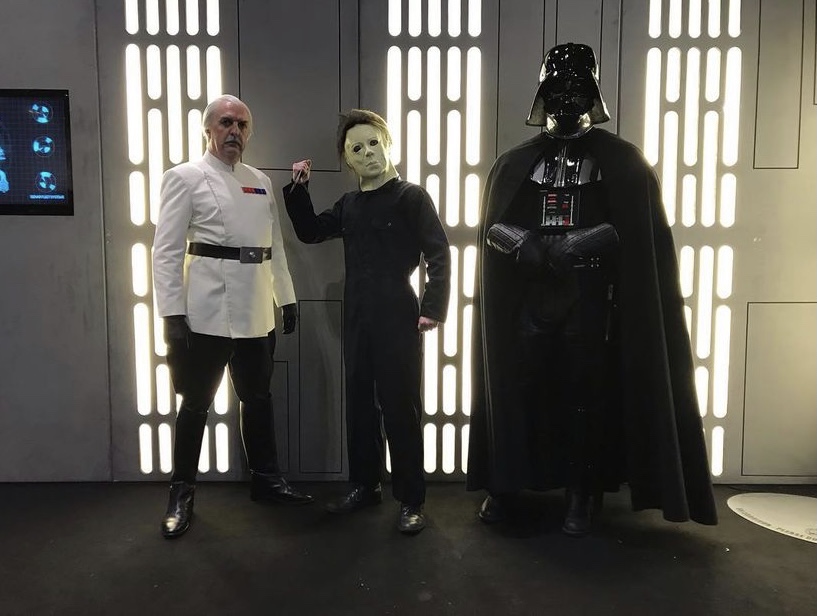
Another big reason as to why I believe Halloween was so culturally impactful was the way in which it successfully dehumanised a person. It’s all well and good having an ominously powerful serial killer as an antagonist to a horror film, but Halloween effectively produced the perfect killer in every sense of the word. Michael doesn’t speak a word for the whole film, the only sound he makes being the iconic breathing used so effectively to signal his presence. Nor do you get a proper glimpse of his face for the entire film, hidden beneath that blank, white, plain William Shatner mask (with the exception of a brief shot of his face as 6-year-old child after he kills his sister Judith Myers). Similarly to what makes Heath Ledger’s Joker so effective in The Dark Knight, Michael Myers has no backstory, no background, no other motives; he just causes harm because he can. Even the iconic boiler suit could be considered to be one of the plainest things a person could wear. Encompassing all this into one creates not a person, but a ‘Shape’ as Michael is famously referred to. That is exactly why Michael Myers is the perfect killer, because he is not a person, he is merely a shape. John Carpenter completely strips a person of everything it means to be human to create the perfect killer, which is why it works so disturbingly well. As Donald Pleasence’s Loomis puts it in the most impactful dialogue of the film – “The blackest eyes, the Devil’s Eyes…what was living behind that boy’s eyes was purely and simply evil.” That is why Halloween was so impactful, it explores the essence of evil and divulges into what it takes to make a person purely and simply, evil.
Such a culturally impactful film has spawned hundreds of follow-ups, not only within the Halloween franchise itself but in the slasher and horror genre in general. It paved the way for films like Friday the 13th, Nightmare on Elm Street, and even the slightly more camp slasher Child’s Play. Not only that, but it also spawned several parody movies such as Scream and Scary Movie which poked fun at the clichés and tropes which were so elegantly established in the original Halloween. 1978’s Halloween showed how infamous a mask and a name can become, and showed how slashers do not have to be violence-centred, but can use suspense effectively to get under the skin of audiences when they least expect it. I would even go as far as to say that the way Halloween used suspense has popped up in non-horror films as recently as the new Bond film, No Time to Die. That in itself shows how far cinema has come yet still employs the same methods of suspense from John Carpenter’s low-budget 1978 film. So far I have enjoyed the newest editions to the Halloween franchise; 2018’s Halloween and this year’s follow-up Halloween Kills. Not only are they essentially a re-imagining of the 1978 classic but with 2010s horror make-over, but they pay brilliant homage to the original by keeping what makes Michael Myers ‘The Shape’ in every sense of the word. If you’re a Halloween fan or a horror fan in general you’re bound to find some enjoyment out of the newest films. But just remember to lock your doors and windows when you leave the house, because you never know who could be watching you from afar…
 G does Films