Asa Butterfield’s poignant stage debut as…Harry Potter? A Review of his stage debut in ‘Second Best’

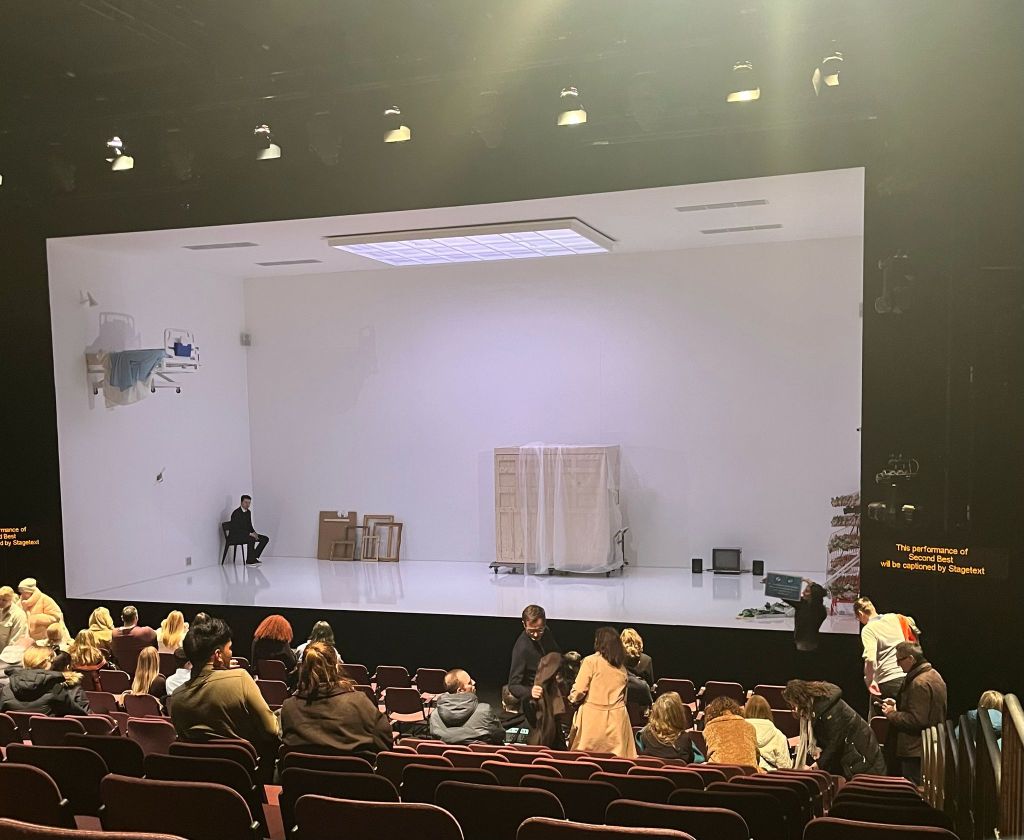
Asa Butterfield is on his own. He sits on a chair on the stage of Studio 2 at Riverside Studios in London. He occasionally gets up to wander around and pass reflective glances at the audience shuffling into their seats. What follows is a story about missed opportunities, fate and family, told solely by Butterfield and strangely revolving around Harry Potter…

Second Best is the fictitious story of Martin Hill, a man, who at 10 years old, was one of the two final contenders to play Harry Potter. Based on a novel of the same name written by David Foenkinos, the one-man play is effectively an uninterrupted monologue of Martin Hill telling the story of his life and the knock-on effect missing out on the role of a lifetime had. Definitely one of the most unique plays I’ve ever seen, not only does it begin with Butterfield already on stage, he continues to be present for the entire duration of the play. Arguably one of the most famous British child actors of this generation, popping up in series’ such as BBC’s Merlin (2008) and Ashes to Ashes (2008), and films like The Wolfman (2010), and Nanny McPhee Returns (2010). Until he received wider recognition for The Boy in the Striped Pyjamas (2008) and Martin Scorsese’s endeavour into the family genre in Hugo (2011). Of course, most young adults will most likely know Butterfield as Otis Milburn from Netflix’s Sex Education.

Arguably dissimilar to his screen work, Second Best allows Butterfield to express his full acting range, from the humorously endearing awkwardness of Otis Milburn to much more poignant, tense emotional moments that the play requires. His exceptional ability to express this range gives the play an undeniable bittersweet feeling. For the most part, it is exceptionally funny, and Butterfield’s comedic timing in the stories he tells land excellently with the audience. However, there are times in the play which deal with loss; not only losing the role of a lifetime, but the loss of family and of one’s sense of self. Butterfield portrays such moments with unexpected sensitivity, evoking great sympathy for Martin Hill and reminds us how easy yet dangerous it is to reflect on what could’ve been.

The stage itself is also very uniquely designed and arranged to reflect the play’s bittersweetness. It is a white room with various seemingly random objects scattered around. From corner shop crisp shelves to a hospital bed affixed high up on the wall, these objects are the only other actors on stage with Butterfield. They act as visual accompaniments to Butterfield’s storytelling, giving the play a personal touch of the things we associate with certain memories and feelings. Moreover, there is a wardrobe from which Butterfield retrieves certain costumes and props, with some hilarious nods to Harry Potter itself. Second Best pokes fun at Harry Potter; the inescapable scale of a global phenomenon and the use of certain terms and phrases to create some admirable irony.

Solely the fact that Butterfield’s stage debut was a one-man play is impressive, but the range he provides in his performance makes it even more so. It was truly wonderful to see a British actor who popped up so frequently in my adolescence and whose roles had some personal resonance with perform on stage. I do hope the reception Second Best has received encourages Butterfield to pursue further theatre endeavours, as he has clearly made the transition from screen to stage with exceptional grace. Second Best was one of the most uniquely funny yet poignant plays I’ve seen, and it is a play I would recommend to anyone who enjoys something different on stage, is an Asa Butterfield fan, or simply even a Harry Potter fan.
The Zone of Interest review: A haunting perspective on blissful ignorance

What do you hear from your house? What noises can you identify from the outside? A dog barking? A lawnmower? Probably nothing beyond mundaneness of everyday life. Now imagine instead of those noises, you hear sounds from the Auschwitz concentration camp from 1943. That is the overall tone of director Jonathan Glazer’s new film, The Zone of Interest.

The film depicts the Höss family, living a seemingly comfortable life next to the camp. The family consists of real-life camp commandant Rudolf Höss, his wife Hedwig, five children, and a dog. It follows their everyday lives, focusing mostly on Rudolf, in balancing his family life with his work. In doing this, the film presents the ultimate juxtaposition; how can one live an idyllic life knowing the atrocities that are occurring right over the wall? Like any good horror film, it’s what you don’t see that haunts you the most.

There’s little to no musical score. When there is, it consists of monotone, ominous soundscapes accompanied with a screen of black or red to force the audience to only imagine the reality of the situation. Otherwise, the film wants you to hear the haunting background noises coming from beyond the wall. This may not be a horror film, but it is arguably more haunting than most modern horror films. The film really wants its audience to feel the blissful ignorance of its characters. With the camp buildings pouring with smoke and looming behind the wall whilst Hedwig shows her mother around the garden, and the fateful sounds of gunfire and shouting as a child plays in his bedroom. It makes the familiarity of household life disconcerting as it shows the true dangers of complacency.

Christian Friedel and Sandra Hüller portray Rudolf and Hedwig, respectively. Hüller having recently been nominated for best supporting actress for the film; her second BAFTA nomination following best leading actress for Anatomy of a Fall. Rightfully so, as she displays the most emotional range in a cast of intentionally deadpan performances. Friedel’s portrayal of Rudolf also provides some depth to his character; showing his disconcertingly relatable love for animals and his family, yet never losing that haunting, emotionless complacency to the reality of his work.

The camera work is notably exceptional, often concisely framing its subject matter in a way which visually juxtaposes the idyllic family life against the backdrop of the camps. As previously mentioned, the camera barely moves. Glazer allegedly placed cameras around the home of the family, allowing their performances to be captured in a natural, almost documentary-style way. Moreover, the camera barely moves throughout the film, concisely capturing what it needs to and intentionally not showing what the audience can only imagine. The film has been nominated for several awards, including best picture, director, adapted screenplay, international feature film, and sound at the Academy awards alone. Similarly to fellow nominees Oppenheimer and Killer of the Flower Moon, The Zone of Interest once again forces its audience to take a glimpse into a dark period of human history to reflect on how disconcertingly easy it was for people to feign ignorance in the face of unspeakable atrocities.

Interestingly, this film is only rated a 12A, which shows how it hides the outright horror and lets the imagination of its audience do the work. Still, that’s not to say it’s not a tough watch. Not much particularly happens in the film, and there is one sequence edited over with a negative filter which seems a little out of pocket until you read up about it afterwards. Nevertheless, not much is meant to happen. Similarly to last year’s controversial yet harrowing Sound of Freedom, its focus isn’t on delivering a conventionally compelling narrative, it is on the idea of what horrible things happen behind closed doors, and how dangerously ignorant we become of it. I don’t think I’ve ever been in a quieter cinema than the one for this film.