My Master Builder at Wyndham’s Theatre – Review

Immediately as I sat down in my seat at Wyndham’s Theatre in London’s West End, I was struck by the unusual structure upon the stage. Resembling a transparent scaffolding, it seemed as if the actors would have little space to perform. The lights went down and on walked Ewan McGregor as a famed architect Henry Solness, giving a speech about the nature of architecture and how it resembles real life. Then, the transparent structure lifted and the audience was introduced to the Solness’s pristine seaside house in The Hamptons, USA. Little did I know that the structure would play a significant part in the play, and would turn out to be the section of a modern Church Henry had designed.

My Master Builder was written by Lila Raicek (in her West End debut) and is based on The Master Builder, an 1892 play written by Norwegian playwright Henrik Ibsen. Director Michael Grandage does not regard Raicek’s play as an adaption or remake of Ibsen’s play, but rather ‘in conversation’ with Ibsen’s. Plot-wise, the two plays share a love triangle with the male lead architect and two women, but Raicek’s brings the two women more to the forefront and allows them to be more layered. My Master Builder is set on the 4th July, with Henry’s wife Elena, a publishing magnate, preparing to throw a party to celebrate her husband’s unveiling of his latest masterpiece. Their brittle marriage is further shaken by the unexpected arrival of Mathilde, a former student of Henry’s, with whom he shares romantic history. As the evening goes on, each is forced to reckon with the past and comprehend how it will affect the future.

As with any tragedy driven by deeply flawed characters, the performances are central to My Master Builder. Indeed, what attracted me to the play was McGregor’s return to the London stage. From Trainspotting to Christopher Robin, McGregor has a wholesome presence like no other. His performance as Henry Solness maintained this to a degree, but is much more thoughtful and nuanced than his more well-known work. Henry is a classical tragic hero; undeniably flawed but sympathetic. Whenever he is around his wife, he is mostly apprehensive and insecure, whereas when he is around Mathilde, he is relaxed, and emotionally as wide-eyed as a child. Whilst McGregor is definitely exceptional, he is almost overshadowed by Kate Fleetwood’s Elena. A stunning stand-out, Fleetwood portrays Elena as sympathetic yet not necessarily likeable. Fleetwood excellently portrays Elena’s emotional vulnerability which builds the tension between her and Henry to a boiling point. Elena’s dry, sarcastic sense of humour was also notable and generated several laughs.

Meanwhile, Elizabeth Debicki’s Mathilde functions as a crux of the play. Being the source of romantic tension that the play hinges on, Mathilde is a victim of the fragile relationship between Henry and Elena. As such, Debicki portrays Elena as much softer than the other characters, with an almost angelic-like quality in her interactions with Henry; whom he sees as a light in the darkness, leading to some genuinely wholesome and passionate moments between them. Supporting cast members David Ayala and Mirren Mack also have their exceptional moments. Ajala portraying Ragnar as the flamboyant, sexually confident friend who alleviates the tension with his comedic timing. Whilst Mack as Elena’s young assistant Kaia was enjoyably enthusiastic in her role and also portrayed a degree of innocence in an environment plagued by emotional turmoil.

The Church set piece which is used throughout the play is almost a character itself. Its incomplete and transparent appearance reflects the characters; no one in the play is entirely happy and feels their lives are incomplete in some way. It signifies the fragility of the relationships, and the way architecture reflects real life. The idea of turning ideas into ‘bricks and mortar’ alludes to how we all have an idealised version of our lives in our head, but making them a reality is never as easy as it seems. As Raicek elegantly puts it, ‘our romantic illusions are often in conflict with the incursions of reality’. A poignant sentiment thoughtfully woven into the performances and relationships between the characters. At certain points Henry climbs the stairs of the church which initiates his vertigo; a wretched irony signifying how even our greatest dreams can be painful once they’re translated into reality.

My Master Builder isn’t anything hugely original or groundbreaking in terms of tragic theatre. The themes and story of flawed lovers chasing an unobtainable dream has been done in countless plays. However, the architectural perspective keeps it relatively fresh and the strong performances make it thoroughly enjoyable. The vulnerability the cast brings to their characters makes it profoundly believable and brings captivating emotional tension.

The mysterious structure on the Wyndham’s stage for My Master Builder.

Asa Butterfield’s poignant stage debut as…Harry Potter? A Review of his stage debut in ‘Second Best’

Asa Butterfield is on his own. He sits on a chair on the stage of Studio 2 at Riverside Studios in London. He occasionally gets up to wander around and pass reflective glances at the audience shuffling into their seats. What follows is a story about missed opportunities, fate and family, told solely by Butterfield and strangely revolving around Harry Potter…

Second Best is the fictitious story of Martin Hill, a man, who at 10 years old, was one of the two final contenders to play Harry Potter. Based on a novel of the same name written by David Foenkinos, the one-man play is effectively an uninterrupted monologue of Martin Hill telling the story of his life and the knock-on effect missing out on the role of a lifetime had. Definitely one of the most unique plays I’ve ever seen, not only does it begin with Butterfield already on stage, he continues to be present for the entire duration of the play. Arguably one of the most famous British child actors of this generation, popping up in series’ such as BBC’s Merlin (2008) and Ashes to Ashes (2008), and films like The Wolfman (2010), and Nanny McPhee Returns (2010). Until he received wider recognition for The Boy in the Striped Pyjamas (2008) and Martin Scorsese’s endeavour into the family genre in Hugo (2011). Of course, most young adults will most likely know Butterfield as Otis Milburn from Netflix’s Sex Education.

Arguably dissimilar to his screen work, Second Best allows Butterfield to express his full acting range, from the humorously endearing awkwardness of Otis Milburn to much more poignant, tense emotional moments that the play requires. His exceptional ability to express this range gives the play an undeniable bittersweet feeling. For the most part, it is exceptionally funny, and Butterfield’s comedic timing in the stories he tells land excellently with the audience. However, there are times in the play which deal with loss; not only losing the role of a lifetime, but the loss of family and of one’s sense of self. Butterfield portrays such moments with unexpected sensitivity, evoking great sympathy for Martin Hill and reminds us how easy yet dangerous it is to reflect on what could’ve been.

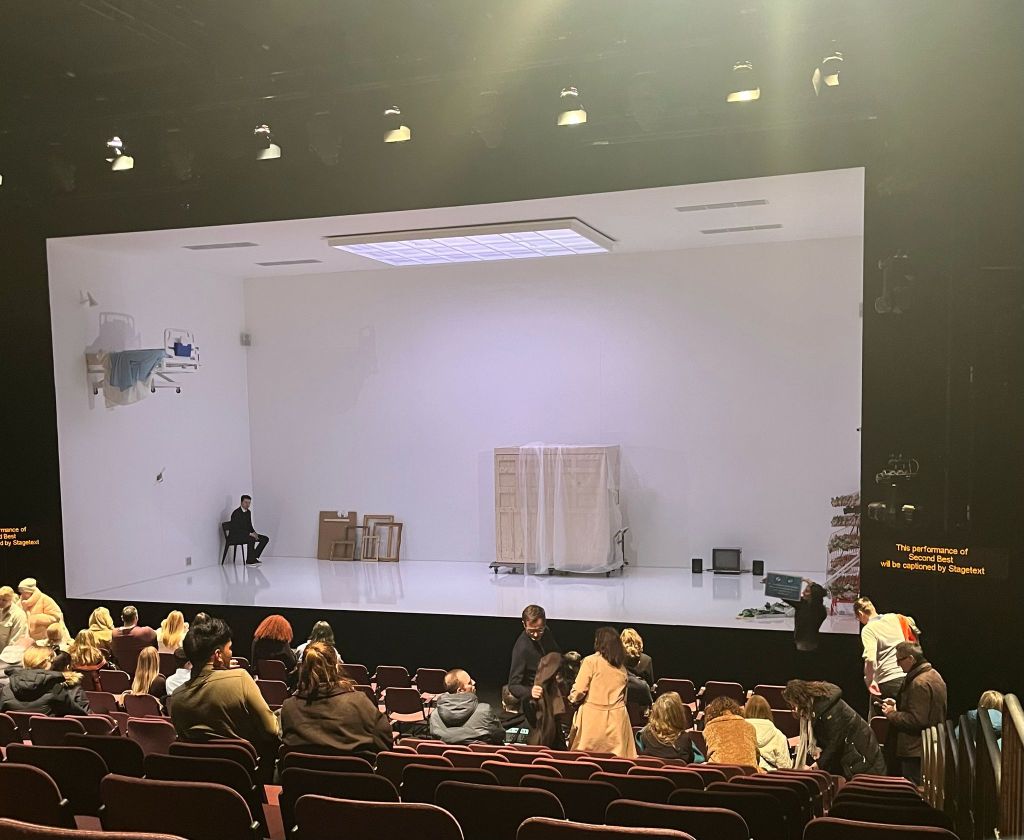
The stage itself is also very uniquely designed and arranged to reflect the play’s bittersweetness. It is a white room with various seemingly random objects scattered around. From corner shop crisp shelves to a hospital bed affixed high up on the wall, these objects are the only other actors on stage with Butterfield. They act as visual accompaniments to Butterfield’s storytelling, giving the play a personal touch of the things we associate with certain memories and feelings. Moreover, there is a wardrobe from which Butterfield retrieves certain costumes and props, with some hilarious nods to Harry Potter itself. Second Best pokes fun at Harry Potter; the inescapable scale of a global phenomenon and the use of certain terms and phrases to create some admirable irony.

Solely the fact that Butterfield’s stage debut was a one-man play is impressive, but the range he provides in his performance makes it even more so. It was truly wonderful to see a British actor who popped up so frequently in my adolescence and whose roles had some personal resonance with perform on stage. I do hope the reception Second Best has received encourages Butterfield to pursue further theatre endeavours, as he has clearly made the transition from screen to stage with exceptional grace. Second Best was one of the most uniquely funny yet poignant plays I’ve seen, and it is a play I would recommend to anyone who enjoys something different on stage, is an Asa Butterfield fan, or simply even a Harry Potter fan.

Waiting for Godot at the Theatre Royal Haymarket – A Review

What are you waiting for?

We’re waiting…for Godot.

Life hinges on asking questions. If we didn’t ask questions, we wouldn’t get anywhere in life. Playwright Samuel Beckett sussed this out when he wrote his surreal play, Waiting for Godot, in the 1940s. The play reflected the hopelessness and uncertainty in a post-WWII world, whilst the satirical banter between its characters giving it a strangely playful side. It was first performed in a tiny Parisian theatre in 1953 and was received very divisively. Understandably so, as the play asks many questions, and potentially leaves the audience asking even more. Today, however, Waiting for Godot is one of the most famous plays ever written, and has been widely regarded as a classic. I recently found out why.

At London’s Theatre Royal Haymarket, there is a stage upon a stage. The actors stand upon a section of barren countryside. There is nothing except Ben Whishaw’s Vladimir looking skyward next to a scraggy tree, and Lucian Msamati’s Estragon sitting on a rock missing a boot. What follows is an exceptionally thoughtful journey into both hopefulness yet hopelessness, and absurdity yet solemnity. The play centres on these two characters who have nothing waiting for a mysterious figure to arrive and give them something. Who is this character? What are they going to do? How do these two men know him? These are all questions left relatively unanswered, and instead the play explores the meaning of life, accepting the absurd, and why we might wait for something that may never come.

Admittedly, I knew very little about this play beforehand. In fact, I wasn’t familiar with any of Samuel Beckett’s work beforehand. Interestingly, I would’ve described the plot of the play the exact same way before watching it as I would after. It isn’t, effectively, about anything in particular. The enjoyment comes from watching the performances and absorbing the conversations. What initially attracted me was Ben Whishaw and Lucian Msamati. Their chemistry and comedic timing carries the majority of the 2 hour and 45 minute runtime. Whishaw’s youthful look and intentionally child-like Vladimir contrasts perfectly to Msamati’s more begrudged, clueless Estragon. If anything, Waiting for Godot proves the two actors are certainly amongst the British greats. Msamati was especially magnetic with his comedic timing and delivery. One such moment occurred when he approached the front of the platform, overhanging the front of the stage, just as some latecomers entered the stalls. Before delivering his line, he stared at them and disappointedly shook his head, gave his line, and there was an instantaneous applause.

Another such moment of audience elation came during a moment with visiting characters Lucky and Pozzo, played by Tom Edden and Jonathan Slinger, respectively. The two pass by Vladimir and Estragon several times in the play, Pozzo a privileged, foppish individual who leads the non-verbal Lucky around on a rope, seemingly to serve him as a slave. When Lucky is told to ‘think’ amongst other actions, a hilariously lengthy, meandering monologue follows about God, man, Earth, whilst the other characters wander cluelessly around the stage waiting for it to end. Once it is abruptly ended by Vladimir, the audience once again applauded. As such, Edden’s performance was notable for its reliance on physicality, generating some particularly hilarious moments when interacting with the other characters. Slinger as Pozzo was also exceptional, seamlessly slipping between his pompous persona and a more regular one to convey some vulnerability to the character. Whether Lucky and Pozzo are reflections of Vladimir and Estragon is certainly implied, but never blatantly obvious. Both pairs of men rely on each other for survival, and are seemingly two sides of the same coin. Their relationships are never defined, as they threaten to leave each other several times, yet rely on each other for companionship as well as survival.

Initially, I thought that writing about Waiting for Godot would be difficult, but now that I have, I can fully appreciate the play’s timeless themes and iconic characters. Never have I been so entranced by such a minimal play, nor have I ever both laughed and reflected in concurrence. This is mainly thanks to Whishaw and Msamati’s extraordinary performances which will certainly go down as one of the best in the play’s history. Waiting for Godot is a play that reminds me why I love going to the theatre and the craft of acting. It relies on so little yet requires so much, allowing the audience to fully appreciate a cast who are well and truly in their element.

Playing Shakespeare with Deutsche Bank: Romeo and Juliet at the Globe Theatre – An exciting, visceral take on a romantic classic

The company of ‘Playing Shakespeare with Deutsche Bank: Romeo and Juliet’ want you to know it isn’t a run-of-the-mill Shakespeare production. There’s graffiti on the walls of Shakespeare’s Globe, a mini skatepark in the centre of the yard, murals to victims of knife crime, and the beginning of the play is signified by a masked hoodlum lurking through the audience on a BMX. Knife crime is not something you’d expect to be so intricately woven into Shakespeare’s most iconic love story. However, when watching a fast-paced, 90-minute adaption set in modern day, it is in fact one of the play’s most integral themes.

Adapting one of Shakespeare’s most well-known plays for a younger, modern day audience is arguably a challenge, but theatre director Lucy Cuthbertson did so with exceptional grace. At a tight 90-minute runtime (the original being over 2 hours), this adaption clearly intended to fully engage its audience and maintain their attention until the tragic end. Not only do the actors constantly interact with audience members, the language maintains its Shakespearean integrity whilst being engaging for a modern audience. Spoken as if it were written today, and delivered by an exceptionally charismatic cast.

The titular characters were played by Hayden Mampasi and Felixe Forde, respectively, whose chemistry made them the most easily likeable characters in a cast of intimidating-looking supporting characters. One of the play’s highlights being the balcony scene – Mampasi standing amid the audience, addressing a smitten Forde leaning out over the Globe’s balcony. Ashley Byam’s performance as Mercutio was also a highlight – a combination of the loveable flamboyance of Ncuti Gatwa’s Eric from Netflix’s Sex Education and Harold Perrineau’s own Mercutio from Baz Luhrmann’s endearing 1996 adaption; Romeo + Juliet.

The action on stage was backed by a trio of percussionists on the back of the stage balcony (Rosie Bergonzi, Zands Duggan and Dave Price), notably so in the Montague and Capulet party scene. The big band-style drumming and percussion made some scenes in the play almost like a musical – the entire cast dancing in sequence which resulted in a rapturous applause. One dance sequence in particular was presented as a hallucination after Juliet drinks the potion. The cast came out dressed as if they were in Mamma Mia! and Simeon Desvignes’ Paris stripped down in the most out-of-pocket scene I’d seen in a Shakespeare play. I understood the appeal intended for a younger audience, but it made me feel as if it took that appeal a little too seriously, which compromised the tone of the scene.

Playing Shakespeare with Deutsche Bank: Romeo and Juliet promised a great introduction to Shakespeare for younger audiences, which I believe it delivered. The performances are engaging enough to keep anyone invested even when the action is minimal and it is simply two characters having a conversation. The choice to set the play in modern South London made it not only easily accessible for today’s younger audience, but also reminded us how resonant its messages still are today. It uses its intricate plot about love spawning from hate to deliver poignant messages about knife crime and gang violence. It is here where this adaption truly shined, and yet again showed why Shakespeare’s work will remain indefinitely exceptional.

Shakespeare’s Globe dressed for a South London version of the bard’s classic love story.

A modern-day ghost story 0n-stage: 2:22 A Ghost Story – A Review

Are ghosts real? This is the question on which playwright Danny Robins’s 2:22 Ghost Story hinges. In the spirit (no pun intended) of the holiday season, I went to see the play at the Criterion Theatre in London’s West End. The play incited many scary and humorous moments, and questions about the existence of the paranormal. The latter is what the 2:22‘s appeal hinges on; in a modern day world surrounded by technology and reliance on scientific explanation, why do we still cling on to beliefs about the paranormal? Are we simply fascinated by the unexplained? 2:22 tells an effective story about how a contemporary household deals with these questions.

2:22 is about two couples; Jenny and Sam who have recently bought a house which they are renovating, and Lauren and Ben, who have been invited to their house for a dinner party. Jenny is convinced the house is haunted, so she gets the party to stay up to 2:22.a.m. to see what transpires. I appreciated the realism of the characters and setting, the cast members are your typical 30-ish, suburban couples maintaining the weight of responsibility of adult life whilst still trying to enjoy themselves. Jenny (Laura Whitmore) is effectively the heart of the play. She is the one taking the paranormal activity the most seriously, especially since she is the mother of a sleeping baby in the room above. Her husband Sam (Felix Scott) however is the opposite of Jenny in many ways, he’s the least open-minded of all of them, sceptical about the paranormal and is always clinging to rational explanations. Tamsin Carroll was exceptionally entertaining as Lauren. Uncertain on where she stands regarding the paranormal, she drinks too much to hide her insecurities. Lauren’s boyfriend Ben (Nigel Allen) was a good contrast to Lauren; a man very sure of himself yet fairly open-minded when it comes to the inexplicable. The cast all had good chemistry, which created a good balance between quippy banter and serious, somber moments. It’s a shame some of their characters weren’t explored more, but then you can only fit so much in a two-hour play centred around one evening in one room.

Huge props (again, no pun intended) must be handed to the production team. The kitchen-diner set felt like somewhere you could actually live, making all the tense paranormal goings-on hit closer to home. From the Monopoly board on the coffee table, to the half-painted walls, it feels like a real living space that matched the characters’ personalities. Set designer Anna Fleischle stated she wanted the set to show the transition between the old and the new; the tension between the two and that the new effectively tears down the old in its place. This tension is not only reflected by the untidy walls and exposed bricks, but also between Jenny and Sam. As the one most concerned with what could be haunting their house from the past, Jenny values what’s left behind more than her husband Sam, who’s lack of sensibility and excessive rationality creates an intriguing conflict. The tensest moments in the play were those in which no word was spoken. Letting a revelation linger in the room for a few moments whilst a light flickers or a baby monitor flashes. Those are the moments which are the most unsettling, and whilst the play has its fair share of jump scares, they aren’t overly relied upon.

2:22 A Ghost Story excels in its exploration of the paranormal. It questions the plausibility of ghosts and if they exist, how would they? What would they do? What would their purpose be in a modern world? It unlocks that underlying fascination people have with the inexplicable. You spend two hours in the company of these two couples, eavesdropping on their alcohol-fuelled bickering. In doing so, it brings genuine tension between the characters, and uses an otherworldly subject matter to spark quarrels about their insecurities and feelings about each other. I think that’s the most unsettling thing about 2:22. It feels genuine, as if it could really happen. I have no doubt 2:22 would make a thrilling adaption as a short film, with some creative cinematography and sound design to recapture the tension seen on stage. We’ve all had the conversation with someone over whether ghosts are real. 2:22 shows how far that conversation could go if we’re given plausible evidence of the paranormal. Are ghosts simply a paradigm used to explain what science cannot? 2:22 heeds caution to the blind sceptic, and opens the mind as to whether ghosts are not simply a paradigm, but could really exist. As Danny Robins playfully puts it, ‘Perhaps the question is not “Do ghosts exist?”, but “Can we exist without ghosts?”

A picture of the set I took on show day